
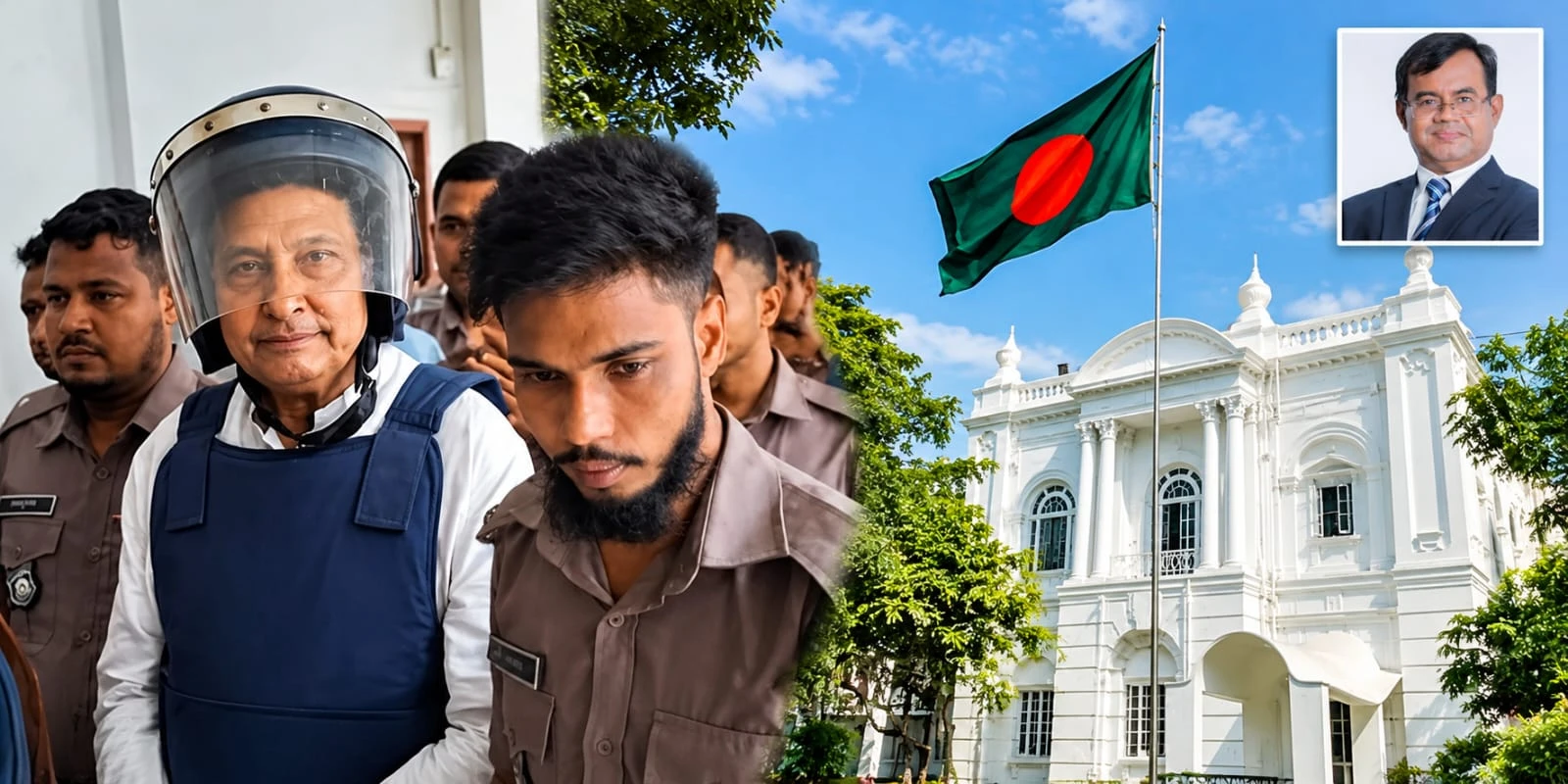
Whatever one thinks of Hasanul Haq Inu’s politics, the treatment of an 80 year old heart patient in custody is a matter for every citizen who believes in the rule of law. According to the JASOD Central Executive Committee, its president has been imprisoned since 26 August 2024, a period of more than two years. On 6 October 2026 the Kashimpur Jail authorities reportedly cancelled the Division 1 status the court had granted him, and he is now said to be housed in a cell with eight other prisoners. A day later he was produced before the International Crimes Tribunal in Dhaka and fell seriously ill on returning to jail. This is not merely a political story. It is a test of how seriously the state takes its own laws.
The medical facts as presented by the party are troubling. Mr. Inu suffered a severe heart attack in 1988, and in 2017 doctors in Singapore implanted an ICD, a device that corrects dangerous heart rhythms. It links to a monitoring server in Singapore, so that his doctors can watch his heart round the clock. After his arrest, the portable monitor attached to the device was reportedly removed by prison authorities and never reconnected. If true, his doctors have been blind to his cardiac condition for over two years. After his illness on 7 October he was kept only in the prison hospital, despite unstable blood pressure and chest pain.
Treatment Is a Right and Not a Favor
A court sentence, or even a pending trial, takes away a person’s liberty. It does not take away his right to life. Article 32 of the Constitution of Bangladesh protects life and personal liberty, and Article 35(5) forbids cruel, inhuman or degrading treatment. Internationally, Bangladesh is bound by the International Covenant on Civil and Political Rights, whose Article 10 requires that people deprived of liberty be treated with humanity and dignity. The UN Standard Minimum Rules for the Treatment of Prisoners, known as the Nelson Mandela Rules, say prisoners should get healthcare of the same standard as the community outside and must be transferred to specialised hospitals when needed. Reconnecting a monitoring device or sending a patient to a cardiac facility is not a concession. It is a legal duty.
Bangladesh’s jail rules allow a division to be granted to certain prisoners on grounds such as social standing, education, age and health. In this case, the CMM court reportedly weighed his family background, education, contribution to sports, role in the Liberation War and national politics, his status as a taxpayer, and his age and illness before granting Division 1. The Deputy Commissioner of Dhaka implemented that order. Its cancellation, reportedly on instructions from higher authorities, raises an uncomfortable question. Can an executive instruction quietly undo a judicial order? The party has cited prison rules 617 and 910 in asking for restoration. If the court’s order was valid, the authorities have to follow it or go back to the court to challenge it. They cannot simply ignore it.
Rights of the Accused and the Meaning of a Fair Trial
A fair trial begins long before the verdict. The presumption of innocence, guaranteed under Article 14 of the ICCPR, means an accused person should not be punished in advance through poor conditions or neglected health. Mr. Inu is said to face over a hundred cases and has to be shown arrested in many of them. Repeated long journeys in prison vans, for a man of his age and condition, are a form of hardship that no hearing schedule can justify. Courts have the power to arrange video appearances, to consolidate hearings, and to order medical examinations. Using these options would serve both justice and humanity.
The government can resolve much of this quickly. It can reconnect the ICD monitor, arrange an examination at a hospital with cardiac care, and reconsider the fresh application filed by his wife on 24 September. It should also explain, in public, who ordered the cancellation of the division and on what legal basis. These steps cost very little and protect the state’s credibility.
Bangladesh was born from a struggle for dignity and justice. A country that remembers this should be the first to insist that even its fiercest political rivals, once in custody, are treated as human beings under the law. A prisoner’s illness is not a political weapon, and it must never become one.
Parvez Hashem, Lawyer and Human Rights Defender


COMMENTS