
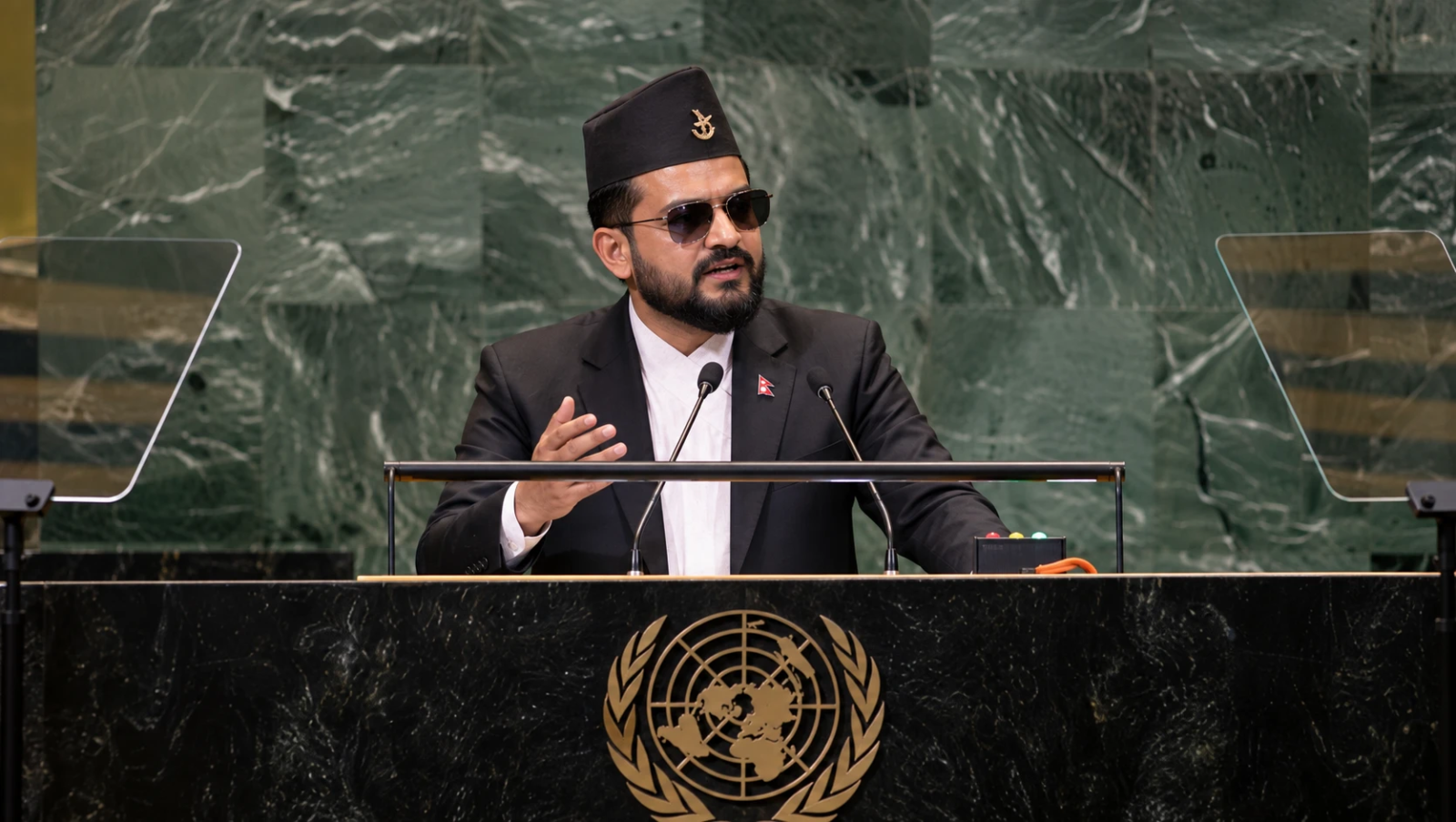
Nepal has called for grant-based international assistance rather than loans to support recovery and reconstruction following devastating glacier-related floods that killed at least 1,450 people, Prime Minister Balendra Shah said in an address to the United Nations General Assembly on Thursday.
Speaking in New York, Shah said the disaster that struck mountainous communities about four weeks ago would require resources equivalent to nearly 10% of Nepal’s gross domestic product (GDP) for recovery and reconstruction.
He argued that countries vulnerable to climate-related disasters should not be forced to take on additional debt to rebuild destroyed infrastructure.
“When a poor country’s infrastructure is destroyed by a climate-induced disaster, the answer cannot be another large loan or a patchwork of small grants,” Shah said, calling for adequate grant-based support from the international community.
The prime minister also urged closer cooperation among Nepal, India and China to strengthen climate resilience across the Himalayan region.
He proposed establishing an emergency mechanism for the Himalayas to facilitate satellite-data sharing, monitor glacial lakes, strengthen early-warning systems and improve cross-border coordination in disaster response.
Shah described the floods as a warning of the growing risks posed by climate change. Roads, bridges, schools, homes and livelihoods were swept away, disrupting Nepal’s development progress, he said.
A glacier collapse near the border between Nepal and China’s Tibet Autonomous Region in late August triggered landslides and flash floods, causing extensive destruction in downstream valleys.
Search and rescue operations were still underway weeks after the disaster, with more than 6,000 people still missing in the affected areas. Shah said many of them might never be found.
Earlier this week, the World Bank approved emergency financing of up to $170 million to help Nepal begin disaster response and recovery efforts.
The comments came as Nepal seeks international assistance to address the scale of destruction and strengthen its resilience against increasingly severe climate-related disasters.





COMMENTS