
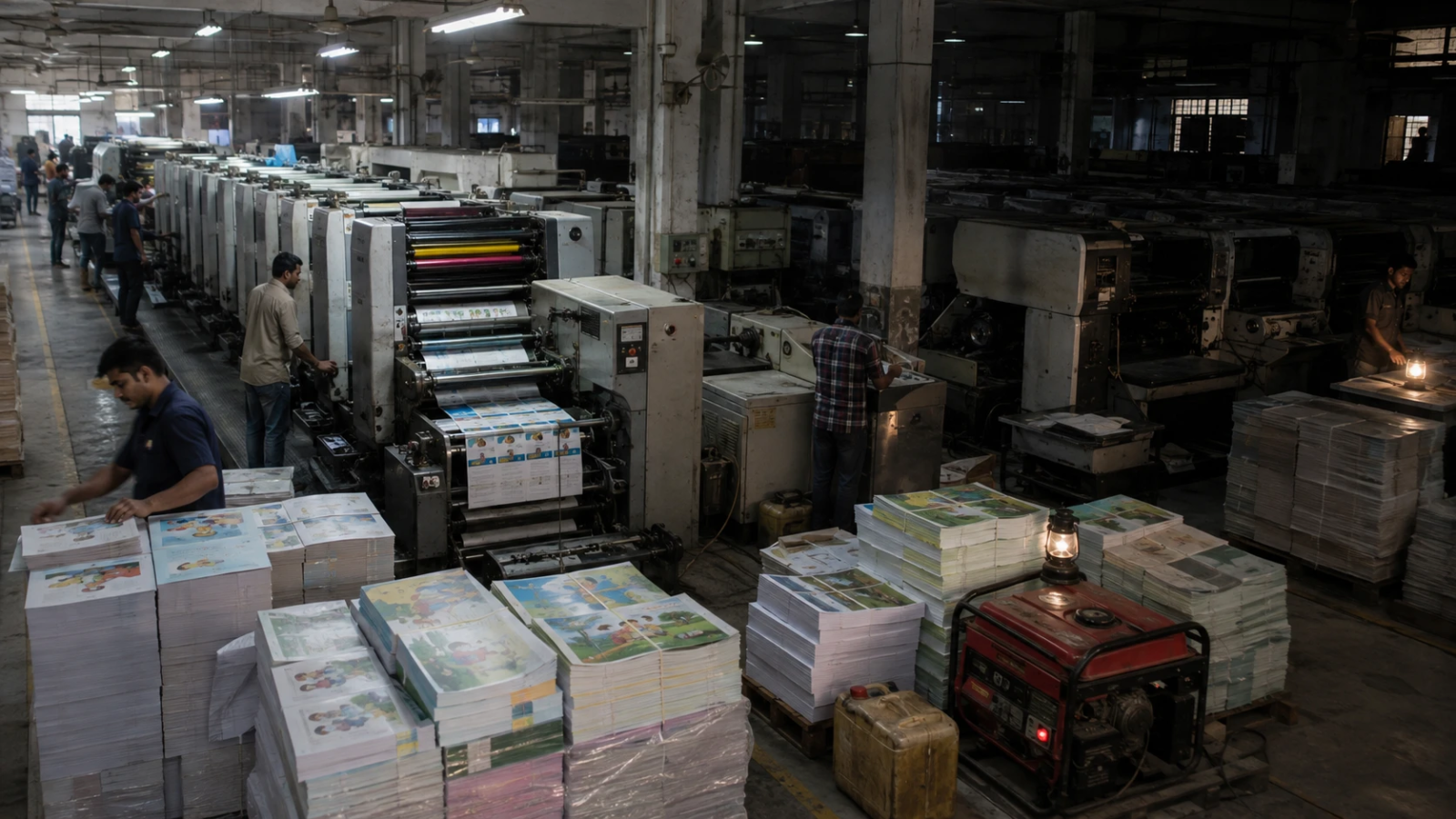
DHAKA — Bangladesh’s efforts to print and distribute textbooks for the 2027 academic year are facing delays as prolonged power outages disrupt production at printing presses, raising concerns about whether students will receive their books on time.
The government plans to print 307,198,101 textbooks for students from pre-primary through secondary, vocational and technical education levels. The National Curriculum and Textbook Board (NCTB), which oversees the programme, aims to complete printing and deliver the books to educational institutions by Nov. 30, ahead of distribution at the start of the new academic year in January.
The country’s nationwide free textbook distribution programme was introduced under the government of former Prime Minister Sheikh Hasina, with the initiative aimed at providing schoolchildren with textbooks at no cost. The programme subsequently became a regular part of Bangladesh’s annual education policy, with millions of students receiving free books at the beginning of each academic year.
The policy was widely presented by the Hasina government as an effort to improve access to education, reduce the financial burden on families and encourage school attendance, particularly among children from disadvantaged households.
The current authorities are continuing the free textbook distribution system, although the scale, curriculum and production arrangements have changed over time.
Printing of pre-primary textbooks for the 2027 academic year has already begun, while production of primary-level books started on Aug. 30. Contracts for secondary-level textbooks were completed on Aug. 31, with printers expected to finish the work within 70 days, according to NCTB officials.
But electricity shortages have emerged as a major challenge, particularly at printing facilities outside the capital.
The NCTB said it had received reports of power outages lasting eight to 10 hours a day at some presses. Smaller printing companies without backup generators have been particularly affected, while larger firms have been using generators, increasing their production costs.
Mohammad Lutfur Rahman, the NCTB’s production controller, said authorities were working to provide more reliable electricity to printing presses.
“Load-shedding is affecting textbook printing, and initiatives have been taken to ensure electricity supply by zone,” he told Bangla Tribune. “Many presses are operating generators. We are hopeful.”
The NCTB sent a letter to electricity distribution companies on Aug. 23, asking them to ensure uninterrupted power supplies to printing facilities involved in the textbook programme.
The board is also coordinating with electricity distribution authorities to reduce outages or limit them to specific periods in areas where printing is under way. The issue is also being raised with the relevant ministry, officials said.
More than 307 million books planned
Of the total planned production, 85.16 million books are earmarked for the primary education sector, including pre-primary students and children from ethnic minority communities. The estimated cost of this component is about 4.60 billion taka.
A further 221.04 million books are planned for Ebtedayee, secondary, Dakhil, vocational and technical education. The estimated cost is about 11.83 billion taka, according to NCTB figures.
The 2027 curriculum will also include several changes. Four new textbooks are expected to be introduced in grades four and six.
Grade four students will receive books titled Sports and Culture of Bangladesh, while grade six will have Joyful Learning and My Technical Education, NCTB officials said.
Effort to avoid previous delays
The authorities are seeking to complete printing and distribution before the academic year begins, after students in previous years faced delays in receiving complete sets of textbooks.
The NCTB has therefore brought forward the printing schedule in an effort to ensure that books are available at the beginning of the school year.
Printing has begun at several facilities, including National Printers and Auto Printers in Dhaka’s Matuail area, as well as at some presses in Bogura, according to the NCTB.
However, officials acknowledged that continued power disruptions could put the timetable under pressure.
The NCTB said it remained optimistic that coordination with electricity suppliers and the use of backup generators would help keep production on schedule.


COMMENTS