
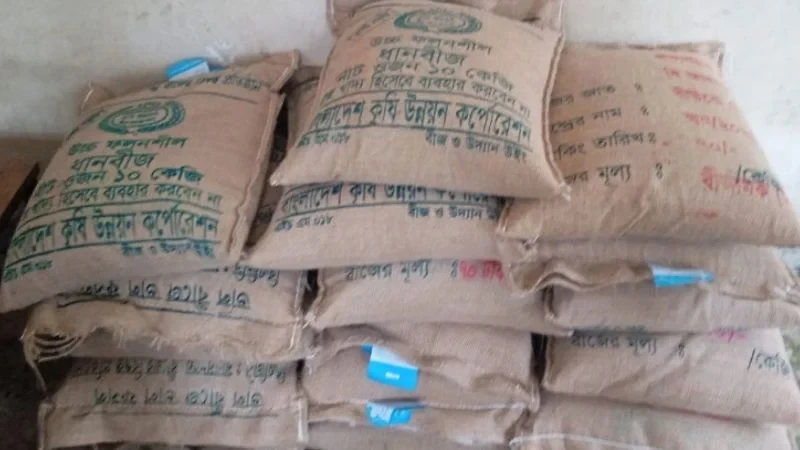
CHATTOGRAM — Local authorities in Bangladesh’s Chattogram district have recovered 13 sacks of government-supplied Aman rice seeds from a madrasa run by a local Jamaat-e-Islami leader, weeks after the seeds were supposed to have been distributed free of charge among farmers.
The seeds were discovered Thursday afternoon at Jameul Ulum Madrasa in Charamba Union of Lohagara upazila during an inspection by Upazila Nirbahi Officer (UNO) Md Bayezid-Bin-Akand.
The madrasa is headed on an acting basis by Shamsul Islam Helali, who is also the amir of Jamaat-e-Islami’s Charamba Union unit.
According to local officials, the UNO noticed a locked room beside the office of the madrasa superintendent during his visit and ordered that it be opened. Inside, officials found sacks of government-provided Aman paddy seeds intended for free distribution among local farmers.
Thirteen sacks were recovered.
The discovery raised questions over why agricultural inputs meant for farmers had remained stored at a religious educational institution instead of reaching their intended beneficiaries.
Authorities subsequently distributed the recovered seeds among farmers and launched an inquiry into how the government supplies ended up at the madrasa.
Madrasa head asked to explain
UNO Bayezid-Bin-Akand said the recovered seeds had already been handed over to farmers.
“The seeds were distributed among farmers after being recovered from the madrasa,” he said while discussing the administration’s action following Thursday’s inspection.
He added that the madrasa superintendent had been formally asked to explain why government seeds were being kept there.
“A show-cause notice has been issued to the superintendent to determine how the government seed sacks came to be at the madrasa,” the UNO said. “Further legal action will be taken after receiving his response.”
The administration has not yet announced any criminal charge in connection with the incident.
The inquiry is expected to determine who took possession of the seeds, why they were stored at the madrasa and whether their delayed distribution resulted from negligence, unauthorized diversion or some other reason.
Seeds were supposed to reach farmers 15 days earlier
Lohagara Upazila Agriculture Officer Kazi Shafiul Islam said the government seeds had been allocated for free distribution among farmers about 20 days before their recovery.
Because Charamba Union is some distance from the upazila headquarters, the agriculture office had sent the seeds through two representatives of local farmers, he said.
“We distributed the government seeds free of charge for farmers 20 days ago,” Shafiul Islam said. “As Charamba Union is far from the upazila, we sent the seeds through two representatives of the farmers. They may have kept the seeds at the madrasa instead of distributing them among the farmers.”
According to the agriculture officer, the seeds should have reached the farmers about 15 days before authorities found them.
“These seeds were supposed to have been distributed among the farmers 15 days ago,” he said, adding that officials were investigating what happened.
The account indicates that the government agriculture office did not itself designate the madrasa as the intended destination of the seeds. Rather, the supplies had been entrusted to intermediaries for delivery to farmers in the union.
The investigation will therefore need to establish the chain of custody after the seeds left the agriculture office and determine who was responsible for ensuring their timely distribution.
Jamaat leader says distribution was delayed because he was busy
Helali acknowledged that the government had provided the seeds for distribution among farmers and that most of them had remained at the madrasa.
He said 17 sacks had originally been supplied, of which four were distributed.
“The government provided 17 sacks of seeds for distribution among farmers,” Helali said. “Four sacks were distributed, while the remaining seeds were kept at the madrasa.”
He attributed the failure to distribute the remaining 13 sacks to being busy.
“The rest could not be distributed because of my busy schedule,” he said.
His statement confirms that the seeds were knowingly stored at the madrasa after only part of the government allocation had reached farmers.
Authorities have not said whether there is evidence that Helali or anyone else intended to sell, misappropriate or otherwise personally benefit from the seeds. The administrative investigation remains underway, and the UNO has said any subsequent legal action will depend on the explanation received and the findings of the inquiry.
Questions over distribution of govt agricultural support
Government-supplied seeds are distributed to farmers as agricultural assistance to support cultivation and reduce production costs. Timely delivery is particularly important because seeds intended for a specific cropping season must reach farmers in time for planting.
In this case, officials say the Aman seeds had remained undistributed for about 15 days after they were supposed to reach beneficiaries.
The recovery therefore raises questions not only about why government property was stored at the madrasa, but also about whether eligible farmers were deprived of agricultural assistance when they needed it.
The agriculture officer’s account also highlights potential weaknesses in the distribution system when government supplies are handed to local representatives for onward delivery without reaching beneficiaries directly.
Officials have not disclosed the total weight or monetary value of the 13 recovered sacks, nor have they said how many farmers were originally supposed to receive them.
For now, the administration says the immediate problem has been addressed by distributing the recovered seeds to farmers. The broader question of responsibility remains unresolved pending the response to the show-cause notice and completion of the investigation.


COMMENTS