
London, June 16 — A planned political event featuring National Citizen Party (NCP) leader and Member of Parliament Hasnat Abdullah triggered hours of tension in East London on Monday as rival groups gathered outside the venue amid deepening political divisions within the Bangladeshi diaspora.
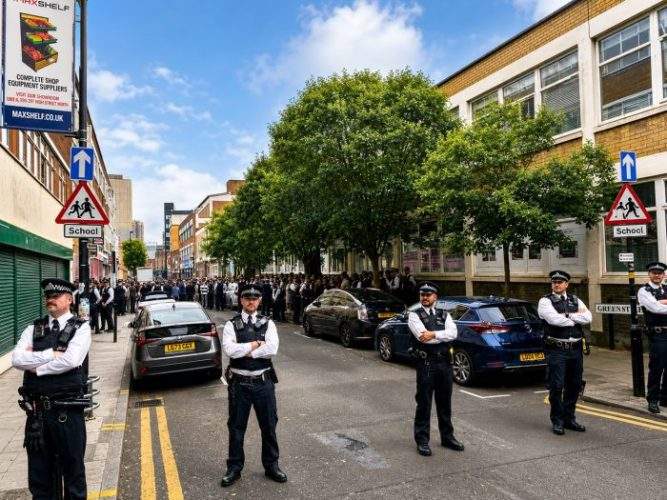
The event, organized by the NCP UK Alliance at Maeda Grill Restaurant near the East London Mosque, drew large numbers of supporters and opponents, prompting a significant police deployment and several arrests.
According to organizers and witnesses, NCP supporters and Awami League supporters gathered outside the venue throughout the afternoon, creating a tense atmosphere that escalated into confrontations, verbal exchanges and egg-throwing incidents.
Police officers formed security cordons around the restaurant as crowds continued to grow. Witnesses said more than one hundred officers were deployed in and around the area to prevent further disorder.
As tensions mounted, Abdullah arrived at the venue nearly three hours after the scheduled start time under heavy police protection. He later delivered his speech and left the premises under police escort.
Arrests Reported Outside Venue
Video footage and eyewitness accounts from the scene showed police detaining several individuals during the disturbances.
Among those seen being taken into custody was Afsar Khan Sadeq, Joint General Secretary of the London Metropolitan Awami League. Images circulating on social media showed him being escorted to a police van in handcuffs.
As of Monday night, London police had not issued a formal statement detailing the arrests or confirming whether charges had been filed.
Earlier Confrontation in East London Park
The unrest outside the restaurant followed an earlier incident in the London Borough of Havering.
According to video footage shared online, Abdullah and several associates were walking through Elm Park in the Romford area at around 4:30 p.m. when a group of individuals began following them and making remarks.
The situation escalated when Abdullah reportedly entered a nearby restaurant. During the confrontation, eggs were thrown toward members of his group.
Video footage appeared to show an egg striking Ehteshamul Haque, Joint Convener of the NCP. An argument then broke out between Haque and Shah Shamim, Office Secretary of the UK Awami League, before developing into a brief physical altercation.
Witnesses intervened to separate the individuals involved, but further tensions reportedly emerged later between another NCP supporter and Shah Shamim.
NCP Alleges Organized Provocation
In a statement, the NCP UK Alliance accused Awami League activists of attempting to create disorder during Abdullah’s visit.
The organization described the incidents as a deliberate act of provocation and alleged that some Awami League supporters attempted to intimidate participants attending the event.
The statement claimed that elements within the Awami League had failed to abandon what it described as a politics of intimidation and intolerance despite major political changes in Bangladesh over the past two years.
Awami League Denies Organizing Protests
Responding to the allegations, Anwaruzzaman Chowdhury, Joint General Secretary of the UK Awami League and former mayor of Sylhet City Corporation, denied that the party had organized any official protest program in connection with Abdullah’s visit.
Speaking to journalists, Chowdhury said the UK Awami League had not announced any activities targeting the NCP leader.
He suggested, however, that students and young members of the Bangladeshi community in Britain may have independently expressed anger over the demolition of the historic residence at Dhanmondi 32 in Dhaka, a site closely associated with Bangladesh’s founding leader Bangabandhu Sheikh Mujibur Rahman.
Political Divisions Spill Into Diaspora Communities
The incident highlights the growing polarization within Bangladeshi communities abroad following the dramatic political upheavals that reshaped Bangladesh after 2024.
Hasnat Abdullah emerged as one of the most prominent figures in the violent anti-government movement that played a central role in the country’s political transformation. He later became a senior leader of the National Citizen Party (NCP), a far-right political party and ally of Jamaat-e-Islami, and was elected to Parliament from Cumilla-4 in an arranged election in which the Awami League was not allowed to contest.
His political activities, however, have generated strong opposition among supporters of the pro-Liberation War political tradition, who argue that the country’s political transition toward Islamization has marginalized millions of citizens and weakened democratic inclusiveness.
The events in East London reflected how those divisions continue to resonate far beyond Bangladesh’s borders.
For several hours on Monday, a neighborhood better known for its vibrant Bangladeshi community became the latest arena for Bangladesh’s bitter political disputes, with police forced to intervene to prevent further escalation.