

Most people are familiar with the term genocide. The United Nations defines it as acts committed with the intent to destroy, in whole or in part, a particular national, ethnic, racial, or religious group. Such destruction can be direct or indirect. It can involve mass killings, but it can also take the form of preventing births within a targeted community, killing newborns, or systematically eliminating a specific population.
Genocide is not confined to wartime. Bangladesh experienced it in 1971 when the Pakistani military unleashed mass slaughter against Bengalis. The Jews suffered it under Hitler’s Nazi regime during World War II. But genocide can also occur during periods that outwardly appear peaceful. During the 1994 Rwandan civil war, rape was used as a weapon, and perpetrators often ensured that no children were born as a result. In Iraq and Syria, policies were pursued to prevent the growth of the Yazidi population. Myanmar’s military junta employed similar tactics against the Rohingya. Genocide, therefore, is not limited to the physical extermination of a group. It can take many forms, a reality recognized in international human rights law.
Many Bangladeshis may not yet realize that after the genocide of 1971, another genocide is now unfolding in the country. This one targets four distinct groups: religious minorities, particularly Hindus; anyone associated with the Awami League; freedom fighters and their descendants; and, finally, the country’s newborn children.
Immediately after the so-called July Uprising of August 5, 2024—which I regard as a militant uprising rather than a democratic movement—religious minorities became direct targets. Following the fall of Sheikh Hasina’s government, Bangladesh was left without an effective administration. Organized mobs emerged across the country to carry out coordinated attacks. These groups were largely composed of activists from Jamaat-e-Islami and its student wing Islami Chhatra Shibir, members of the banned extremist organization Hizb ut-Tahrir, as well as activists from the BNP and Jatiyatabadi Chhatra Dal.
Five days later, Muhammad Yunus arrived from France and assumed power. Many hoped the situation would improve. The opposite happened. Instead of dismantling mob rule, his administration legitimized it. Members of his inner circle insisted these were not mobs at all but “pressure groups.”
Across Bangladesh, these groups selectively attacked minority homes and businesses. Houses were destroyed. Men were beaten, hanged from trees, and burned alive. Women were raped. Survivors were forced from their villages, and many fled the country altogether. The victims included laborers, teachers, doctors, and professionals from all walks of life. Numerous Hindu civil servants lost their jobs.
At the Sardah Police Academy in Rajshahi, nearly 300 cadets were dismissed just before graduation. Most were either children of Awami League families or members of religious minority communities.
The persecution did not stop with minorities. It quickly expanded to anyone associated with the Awami League. If one member of a family had been involved in the party, the entire family became a target. A new label emerged: “accomplice of the autocrat.”
The list of so-called accomplices soon included schoolteachers, university vice chancellors, professors, physicians, and countless other professionals. When the intended targets could not be found, their families were attacked instead.
Freedom fighters and their descendants were not spared. Their crime was simple: they had helped break Pakistan apart and create Bangladesh. People who once proudly identified themselves as freedom fighters were forced into hiding. Families receiving freedom fighter allowances were driven from their homes and compelled to relocate elsewhere.
The final group caught in this unfolding tragedy is Bangladesh’s children.
Because of what I view as the Yunus administration’s catastrophic negligence, the country has faced a severe measles epidemic driven by vaccine shortages. Thousands of children have been infected, and hundreds have died. Official figures indicate that more than 700 children have already died from measles. Unofficial estimates place the number far higher.
Bangladesh has long battled infectious diseases such as cholera, smallpox, malaria, dengue, typhoid, chikungunya, and Black Fever. In earlier decades, entire villages were devastated by such outbreaks. During the early months of the 1971 Liberation War, smallpox killed thousands, leaving so many dead that there were not enough people to bury them.
Through decades of coordinated public health efforts, Bangladesh had largely brought these diseases under control. That achievement belongs to more than one government, but one of its most significant advances occurred during Sheikh Hasina’s tenure.
The clearest example came during the COVID-19 pandemic. While millions died around the world, Bangladesh’s death toll stood at roughly 29,500. India lost more than 533,000 people. The United States lost more than 1.2 million. Bangladesh emerged as one of Southeast Asia’s strongest performers in controlling the pandemic. Economic growth remained close to 5 percent, among the highest in South Asia.
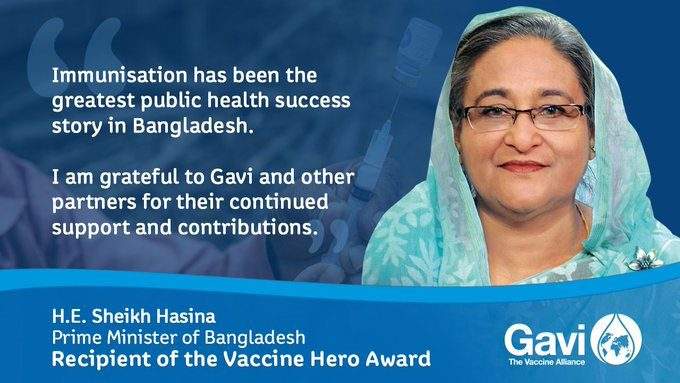
The same commitment was visible in the national immunization program. Measles outbreaks had been widespread between 2000 and 2006, but infections began to decline after 2007. When Sheikh Hasina returned to power in 2009, her government prioritized vaccination. The United Nations, UNICEF, Gavi, and the World Health Organization supported the effort. Vaccines were distributed through community clinics nationwide, while extensive public awareness campaigns encouraged participation.
Over fifteen years, the program became one of Bangladesh’s greatest public health successes. In 2019, UNICEF and Gavi jointly honored Sheikh Hasina at the United Nations headquarters with the title “Vaccine Hero.” Available information shows that mass immunization efforts continued uninterrupted until June 2024.
Then everything changed.
After the July uprising, Muhammad Yunus assumed power through what I consider an illegitimate seizure of state authority. He remained in office until February 17, 2026. Following an election held without the participation of the Awami League, the BNP formed a government under Tarique Rahman.
Yunus’s tenure will be remembered as one of the darkest chapters in Bangladesh’s history. Among his most damaging decisions was dismantling the established measles vaccination program. He decided vaccines would no longer be procured through Gavi under the existing system but through open tenders instead. Whether motivated by political interests or other ambitions, the result was disastrous.
At the same time, those working within the vaccination program reportedly saw their salaries halted.
UNICEF’s representative in Bangladesh, Rana Flowers, reportedly warned Yunus repeatedly against the decision. At least five letters were sent urging him not to proceed. The warnings went unheeded.
Meanwhile, measles infections continued to rise. By the time Tarique Rahman assumed office, the situation had escalated into a full-scale epidemic. Conditions may have improved somewhat since then, but hospitals still lack sufficient beds for infected children.
Several individuals have sought legal accountability for what they describe as Yunus’s misconduct. Yet the courts have effectively made it clear that no trial of Yunus will take place in Bangladesh. The implication is obvious: permission from higher authorities is absent.
The public has gradually come to understand that the Tarique Rahman government is little more than an extension of the Yunus administration. It is worth remembering that even U.S. President Donald Trump has had to answer before a court of law.
When these developments are examined together, the conclusion becomes difficult to avoid. By the standards set out in international definitions of genocide, Muhammad Yunus’s rule involved actions that contributed to multiple forms of group destruction and persecution. He may never face justice in a Bangladeshi courtroom, but history will deliver its verdict.
History does not forgive.
Author:Syed Iftekhar Hossain is a political anylist.