

Bangladesh today marks June 7, Historic Six-Point Day, commemorating the movement that laid the political foundation for the country’s independence.
Yet the day is passing in near silence. No major public programs have been announced to observe one of the most consequential chapters in the nation’s history, amid an increasingly restrictive environment for the Awami League and supporters of Bangladesh’s liberation-war legacy.
The BNP-led government was never expected to observe the day. Meanwhile, its friendly opposition in Parliament, Jamaat-e-Islami—the anti-liberation-war party—remains at odds with the legacy of the Six-Point Movement.
The muted observance comes as the Awami League—the party that led the Six-Point Movement and later guided Bangladesh’s struggle for independence under Bangabandhu Sheikh Mujibur Rahman—remains banned from political activities. At the same time, public space for commemorating the nation’s liberation-era legacy continues to shrink.
The contrast is striking. Six decades after the bloodshed of June 7, 1966, when demonstrators were killed while demanding autonomy for East Pakistan and the release of Sheikh Mujibur Rahman, the anniversary of that historic movement is being observed without the large-scale commemorations that once marked the occasion.
For historians and political observers, the subdued observance reflects more than the absence of public programs. It underscores a broader struggle over historical memory at a time when the party that spearheaded both the Six-Point Movement and Bangladesh’s independence struggle remains barred from political activities, leaving many of the movement’s traditional supporters unable to publicly commemorate the day.
The Six-Point Movement, launched by Bangabandhu Sheikh Mujibur Rahman in 1966, is widely regarded as the Magna Carta of the Bengali nation’s struggle for self-rule. The movement transformed demands for autonomy into a mass political awakening that ultimately culminated in the birth of Bangladesh in 1971.
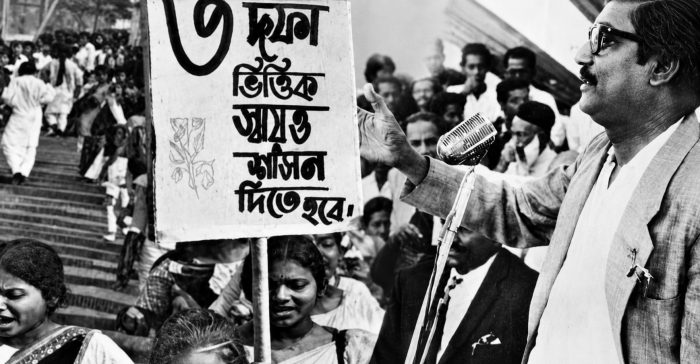
The Program That Changed History
On Feb. 5, 1966, Sheikh Mujibur Rahman unveiled his historic Six-Point Program at a conference of opposition political leaders in Lahore. At a time when East Pakistan faced deep political marginalization and economic discrimination, the proposals offered a constitutional roadmap for self-governance and economic justice.
One of the central demands called for a federal structure based on the Lahore Resolution of 1940, under which the central government would retain authority only over defense and foreign affairs. The program also sought separate fiscal arrangements for East and West Pakistan, provincial control over taxation and revenue collection, separate foreign-exchange accounts, and the establishment of a separate militia or paramilitary force for East Pakistan.
At the time, Pakistan’s ruling establishment denounced the Six Points as a separatist agenda. In East Pakistan, however, the program quickly became the rallying cry of a population increasingly frustrated by decades of economic exploitation, political exclusion, and unequal treatment.
Economic data from the period revealed stark disparities between the two wings of Pakistan. Although East Pakistan generated a substantial share of the country’s export earnings, particularly through jute exports, it received a disproportionately small share of development spending and public investment. The Six-Point Program gave political expression to these grievances and galvanized support across East Pakistan.
June 7: The Day That Changed the Movement
The Six-Point Movement reached a decisive turning point on June 7, 1966, when a provincewide hartal was called to demand the release of Sheikh Mujibur Rahman and other leaders arrested for championing the program.
Despite widespread repression, the strike drew massive participation throughout East Pakistan. Historical records indicate that Awami League leader Amena Begum played a crucial role in organizing the movement and mobilizing support across the province.
As demonstrators took to the streets in Dhaka, Narayanganj, and other areas, police and members of the then-East Pakistan Rifles opened fire.
Eleven people, including Manu Mian, Shafique, and Shamsul Haque, were killed during the demonstrations.
Their deaths transformed the Six-Point Movement from a constitutional campaign into a mass uprising. The bloodshed ignited public outrage, broadened support for autonomy, and established Sheikh Mujibur Rahman as the undisputed leader of the Bengali nationalist movement.
Reflecting on the struggle, Bangabandhu later wrote in his memoirs that repression and imprisonment could not suppress the aspirations of the Bengali people. Throughout his political life, he consistently described the Six Points not as a blueprint for separation but as a program for the survival, dignity, and democratic rights of Bengalis.
From Autonomy to Independence
Political historians often describe the Six-Point Program as the first formal blueprint for Bangladesh.
The movement laid the political and intellectual foundation for the 1969 Mass Uprising, inspired the student-led Eleven-Point Movement, shaped the overwhelming mandate delivered in the 1970 general election, and ultimately contributed to the Liberation War of 1971.
The connection between the Six Points and independence became unmistakable in Sheikh Mujibur Rahman’s historic March 7 speech.
“The struggle this time is the struggle for our emancipation; the struggle this time is the struggle for independence,” Mujib declared before hundreds of thousands gathered at the Racecourse Maidan in Dhaka on March 7, 1971.
Historians widely regard the Six-Point Movement as the bridge between the autonomy movement of the 1960s and the independence struggle that led to the creation of Bangladesh.
A Legacy Under Pressure
The subdued observance of Six-Point Day this year has reignited debate over how Bangladesh remembers the political struggles that gave birth to the nation.
The movement that once united millions of Bengalis against political domination now receives far less public attention than in previous decades. With Awami League barred from political activities and many of its leaders unable to organize public events, one of the defining chapters of Bangladesh’s history is increasingly absent from the national conversation.
Supporters of preserving the movement’s legacy argue that the sacrifices of June 7 transcend partisan politics. They contend that the martyrs who gave their lives for autonomy and democratic rights belong to the collective memory of the nation and should be commemorated regardless of contemporary political disputes.
The lack of major public observances this year has therefore raised broader questions about how Bangladesh preserves and transmits its liberation-era heritage to future generations.
Enduring Relevance
Sixty years after the bloodshed of June 7, the issues at the heart of the Six-Point Movement—representation, accountability, economic justice, and political rights—continue to resonate in Bangladesh’s public discourse.
The movement’s enduring significance lies not only in what it achieved but also in what it symbolized: the determination of a people to demand equality, dignity, and the right to shape their own future.
As Bangladesh marks another Six-Point Day in relative silence, the contrast between the movement’s historic importance and its subdued observance serves as a reminder that the struggle over history is often inseparable from the politics of the present.
The martyrs of June 7 helped change the course of South Asian history. Whether their sacrifices continue to occupy a central place in Bangladesh’s public memory may prove to be one of the defining questions of the country’s contemporary political era.