
The year 2024 has emerged as one of the most contentious periods in Bangladesh’s recent history, marked by widespread unrest, sharply divided narratives, and ongoing disputes over casualty figures and accountability. Competing claims from political actors, media outlets, and civil society groups have made it increasingly difficult to establish a single, widely accepted account of events.
Critics of the movement that unfolded during that period describe it as violent and destabilizing, alleging that anti-state elements, misinformation, and politically motivated campaigns played a central role. They argue that social media rumors, sensationalist reporting, and financial incentives contributed to the rapid spread of unverified claims, particularly regarding the number of casualties.
One of the most widely circulated allegations during the unrest was that thousands of students had been killed at Dhaka University and other institutions. However, subsequent reporting by local media outlets challenged those figures. A report by RTV indicated that among 114 individuals buried in Rayerbazar, some deaths were unrelated to the movement, citing causes such as road accidents and poisoning. Similarly, a report by Kaler Kantho on March 2 noted that at least one individual listed in official records had died from alcohol-related illness rather than protest-related violence.
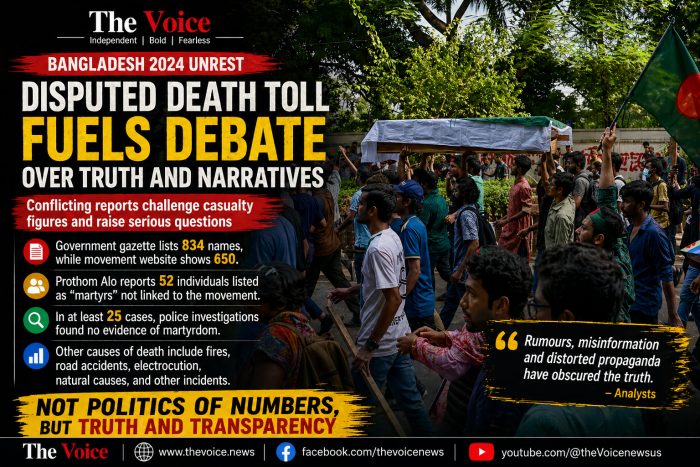
Further scrutiny intensified following a September 15, 2025 report by Prothom Alo, which claimed that 52 individuals had been included in the official list of “martyrs” despite not meeting the criteria. According to the report, families of several listed individuals confirmed that their relatives had not died during the unrest. Police investigations in at least 25 cases reportedly found no evidence linking those deaths to the movement.
Local reviews and document analysis cited in the same report pointed to alternative causes of death among those listed in the gazette, including fire-related incidents (35), road accidents (3), electrocution (1), natural causes (2), prior conflicts (4), and other causes (2). These findings added to growing concerns about the accuracy of official casualty records.
Additional media investigations raised allegations of manipulated images, fabricated identities, and irregularities associated with financial disbursements. Reports suggested that some individuals may have been falsely declared dead to file legal cases or obtain compensation. In one instance, Desh TV reported that legal action had been initiated over claims involving a person who was still alive. ATN News also cited accusations that fabricated martyr identities had been used to access financial benefits.
The controversy deepened with discrepancies in official figures. While a government gazette reportedly listed 834 deaths, the website of the Anti-Discrimination Movement cited a total of 650. This inconsistency fueled further debate about the reliability of data and the processes used to compile it.
Statements by political leaders also came under scrutiny. A claim by Jamaat-e-Islami Amir Shafiqur Rahman that he had visited the homes of 1,200 victims was questioned by critics, who argued that such a figure exceeded even the highest officially acknowledged numbers. They noted that given the timeline since August 5, 2024, verifying and visiting that many households would be practically difficult.
Adding to the complexity, a United Nations report covering July 1 to August 15 cited a total of 1,400 casualties. Analysts note that this figure likely includes both deaths and injuries, though interpretations vary. If the lower figure of 650 deaths is considered, questions remain about how the broader casualty count should be understood and categorized.
The debate over numbers is not merely statistical—it reflects deeper political divisions over responsibility and narrative control. Critics aligned with the previous government argue that many deaths occurred in post-August 5 violence targeting supporters of the Awami League, and that conflating all casualties under a single label risks distorting the historical record.
Since the removal of Prime Minister Sheikh Hasina on August 5, 2024, and the installation of an interim administration led by Nobel laureate Dr. Muhammad Yunus, Bangladesh has faced sustained political and social tensions. Rights groups have reported widespread violence, with Ain O Salish Kendra documenting at least 318 deaths in early August alone. The Bangladesh Hindu, Buddhist, Christian Unity Council reported more than 2,000 incidents of violence against minority communities within weeks of the transition.
In this charged environment, analysts emphasize the need for transparent investigations, credible data verification, and responsible reporting. Without these, they warn, conflicting narratives may continue to deepen divisions and complicate efforts to establish an accurate historical account of one of Bangladesh’s most turbulent chapters.