

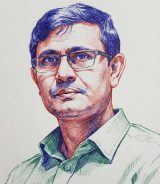
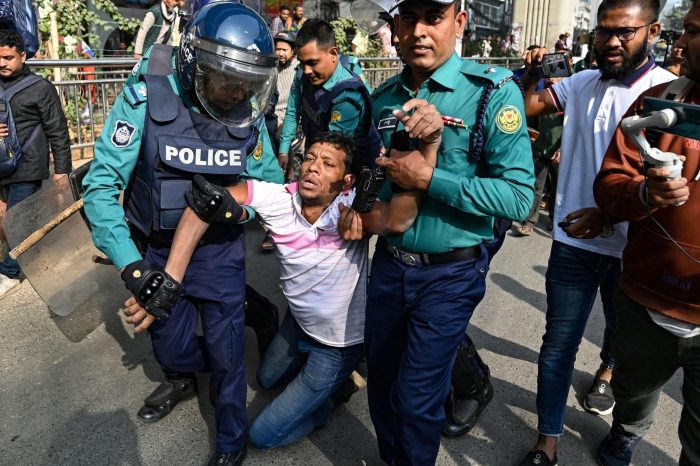
On April 17, 2026, A.M. Hasan Nasim was taken into custody after sharing a satirical cartoon online. Days earlier, on April 5, Sawoda Sumi had been detained in Bhola over alleged “anti-government” Facebook posts. On March 31, Azizul Haque was arrested in Muktagachha following complaints by ruling-party activists, later facing charges that escalated from routine criminal provisions to cyber and anti-terror laws. Around the same time, Shaon Mahmud was reportedly picked up by political activists before being handed over to police and charged under the Anti-Terrorism Act for online remarks.
Individually, these cases may appear limited. Taken together, they form a pattern—one that signals not only repression, but a deliberate strategy of intimidation. The message is unmistakable: dissent, even in its mildest or most satirical form, carries risk.
What makes this pattern more disturbing is that it does not represent a break from the past. It is a continuation.
The Shadow of an Unelected Order
To understand the present, one must return to the period following August 2024, when an interim authority led by Nobel laureate Muhammad Yunus assumed control after the removal of Sheikh Hasina. That transition was framed as a corrective moment. In practice, it became something far darker.
Human rights organizations and local monitors documented widespread abuses during that period. Ain o Salish Kendra reported that at least 318 people, including children, were killed in just the first few days of unrest between August 5 and 8, 2024. The Bangladesh Hindu Buddhist Christian Unity Council cited more than 2,000 incidents of violence—including killings, assaults, and arson attacks—within weeks of the political transition.
Beyond the immediate violence, a systematic campaign of repression took hold. Journalists were among the primary targets. Hundreds were implicated in sweeping and often implausible murder cases, widely viewed by rights advocates as fabricated to create a climate of fear. Many were detained. Prominent reporters, editors, and cultural figures remain incarcerated to this day, detained for prolonged periods without trial. Among them are distinguished journalists such as Shahriar Kabir, Mozammel Babu, Shyamal Dutta, Shakil Ahmed, and Farzana Rupa.
The crackdown extended well beyond the media. Political leaders, academics, and members of the cultural community were arrested in large numbers. Some died in custody. Homes were raided. Dissenting voices were silenced. Institutions that should have provided protection instead appeared to facilitate repression.
This was not a transitional phase marked by instability. It was a restructuring of power—one in which coercion became a governing tool.
From Interim Authority to Elected Continuity
The February 2026 election, which brought the Bangladesh Nationalist Party (BNP) to power under Tarique Rahman, was presented as a return to democratic order. But the credibility of that process remains deeply contested.
The country’s largest political force, the Awami League, was effectively sidelined and barred from participation. Opposition space was restricted. The electoral environment was shaped long before ballots were cast.
In that context, the outcome appeared less like a competitive democratic exercise and more like a managed transition—one that ensured the consolidation of power by forces aligned during the interim period, including Islamist political actors such as Jamaat-e-Islami.
Seen in this light, the current government does not represent a departure from the Yunus-era framework. It represents its institutional continuation.
Repression Refined, Not Reversed
The arrests unfolding today reflect a system that has been refined, not reformed.
Legal instruments such as the Cyber Security Ordinance and the Anti-Terrorism Act are now being deployed with precision. Their broad definitions allow authorities to convert political expression into criminal conduct with minimal justification. A Facebook post becomes a security concern. A cartoon becomes a legal case. A critic becomes a suspect.
Human Rights Watch has warned that such actions reflect “an alarming continuation of the previous government’s repressive practices.” The organization’s assessment underscores that the issue is not tied to one administration alone, but to a deeper institutional culture that prioritizes control over rights.
Meenakshi Ganguly, Deputy Asia Director at Human Rights Watch, further noted that the persistence of such arrests so soon after a change in leadership suggests that “security sector abuses have become entrenched.”
This entrenchment is visible not only in law enforcement behavior, but in the broader ecosystem of governance. Complaints originating from political actors trigger legal action. Courts provide limited resistance. The distinction between state authority and partisan interest becomes increasingly blurred.
A Climate of Fear That Never Lifted
For many in Bangladesh, the fear that took hold during the interim period never truly disappeared. It simply evolved.
Journalists continue to operate under threat. The legacy of mass cases and prolonged detention has created a chilling effect that extends far beyond those directly targeted. Cultural activists and intellectuals remain cautious, aware that boundaries are undefined and consequences unpredictable.
The continued detention of high-profile journalists without trial stands as a stark reminder that the system remains intact. Justice delayed in such cases is not merely administrative failure—it is a form of pressure.
In this environment, self-censorship becomes not a choice, but a survival strategy.
The Erosion of Democratic Meaning
Democracy is not defined solely by elections. It is defined by the conditions under which those elections take place, and by the freedoms that exist between them.
When a major political party is excluded, when dissent is criminalized, and when fear shapes public discourse, the substance of democracy is weakened—regardless of the formal process.
The current trajectory raises fundamental questions about the direction of governance in Bangladesh. Is the state moving toward a system where power is checked by law? Or toward one where law is shaped by power?
So far, the evidence points to the latter.
A Continuum, Not a Break
It would be convenient to view the present situation as a series of isolated missteps by a new administration. But that would miss the larger reality.
What Bangladesh is experiencing is not a break between two different political orders. It is a continuum—one that stretches from the interim authority led by Muhammad Yunus to the current government under Tarique Rahman.
The faces have changed. The methods have not.
The same patterns of arrest. The same use of broad laws. The same targeting of critics. The same institutional weaknesses. Together, they form a system that is resilient not in protecting rights, but in restricting them.
The Stakes for Bangladesh
The stakes could not be higher. A country with a long history of political struggle and democratic aspiration now finds itself confronting a familiar dilemma: whether to accept a managed political order or to demand genuine reform.
Reform would require more than rhetoric. It would require dismantling the legal and institutional tools that enable repression. It would require restoring judicial independence. It would require ensuring that no citizen is arrested for expressing an opinion.
Most importantly, it would require a fundamental shift in how power is understood—not as something to be defended at all costs, but as something to be exercised within limits.
A Warning Ignored
The early warning signs are already visible. Arrests over social media posts. Continued detention without trial. Laws applied selectively. Institutions that fail to act as safeguards.
These are not anomalies. They are indicators.
If left unaddressed, they will define the next chapter of Bangladesh’s political story—one in which the promise of change gives way, once again, to the reality of control.
And for a public that has already paid a high price in its struggle for rights and representation, that would be more than a disappointment. It would be a profound betrayal.
Writer: Pulack Ghatack, journalist