
The inaugural session of Bangladesh’s 13th National Parliament has sparked intense political debate, with analysts and observers highlighting both the symbolic tone of the proceedings and the broader political transition unfolding in the country.
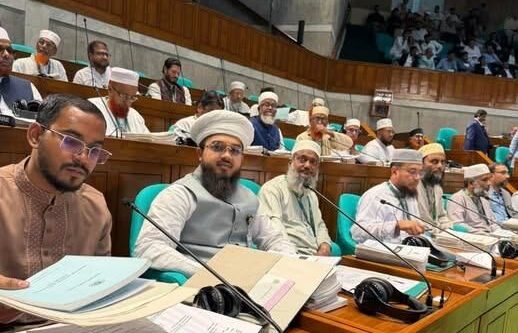
The first sitting of the new parliament began on 12 March at the Jatiya Sangsad Bhaban in Dhaka, nearly a month after the February 2026 general election. Lawmakers gathered to begin the legislative term amid expectations that the new parliament would play a stronger role in debate, oversight, and policy deliberation. The session opened with introductory remarks from parliamentary officials followed by a recitation from the Holy Quran before lawmakers began formal proceedings.
The newly formed parliament emerged after a decisive electoral victory by the Bangladesh Nationalist Party (BNP), led by Prime Minister Tarique Rahman, which secured a clear parliamentary majority. The parliament consists of 300 directly elected members along with reserved seats, forming the 13th Jatiya Sangsad, the country’s unicameral national legislature.
Yet despite expectations of a fresh start in the country’s political life, the opening session quickly became the subject of controversy and debate.
Historical References Missing from Opening Proceedings
Many political observers noted the absence of references to Bangladesh’s founding history during the inaugural proceedings.
In previous parliamentary openings, speeches often acknowledged the Liberation War of 1971 and commemorated the sacrifices of the country’s martyrs and freedom fighters. The war, which led to the establishment of Bangladesh as an independent state after a brutal conflict with Pakistan, remains the central pillar of the nation’s political identity.
However, the opening of the 13th parliament took place without direct references to Bangabandhu Sheikh Mujibur Rahman, the country’s founding leader, or to the Liberation War itself.
The omission sparked debate among historians and political commentators about the symbolism of the moment and whether it reflected a broader shift in the political narrative surrounding Bangladesh’s independence.
March carries deep historical meaning in Bangladesh. It was during March 1971 that Sheikh Mujibur Rahman delivered his historic speech calling for resistance and national unity, a moment widely considered a turning point that led to the independence struggle.
For critics, the absence of these historical references during the inaugural parliamentary proceedings raised questions about the direction of the country’s political messaging and institutional symbolism.
Political Rivalries and Competing Narratives
Bangladesh’s political landscape has long been shaped by rivalry between the Awami League and the BNP, two parties that have alternated in power for decades.
While the Awami League traces its legitimacy to the leadership of Sheikh Mujibur Rahman and the Liberation War, the BNP historically emphasizes the role of former president Ziaur Rahman in the independence struggle.
These competing narratives have frequently influenced political discourse, education, and national commemorations.
During the opening session, references to political figures associated with the BNP era were reportedly made several times, further intensifying debate over how national history is represented in public institutions.
Political analysts say the contest over historical memory remains a defining feature of Bangladesh’s political culture.
A Session Marked by Political Tension
The parliamentary opening also saw moments of visible political tension.
When President Mohammed Shahabuddin arrived to deliver his address to the newly elected parliament, members of an opposition alliance staged a protest inside the chamber, displaying placards and chanting slogans before walking out of the session. The demonstration reflected continuing disagreements over the legitimacy of political decisions made during the country’s recent transition period.
The protest highlighted the fragile political atmosphere surrounding the new parliament.
Experts have warned that the legislative body could face constitutional and political challenges as it attempts to reconcile competing reform agendas and political mandates that emerged following the upheaval of 2024.
Political Transition and Institutional Realignment
Bangladesh’s current political moment follows a dramatic period of upheaval.
The political environment shifted significantly after the mass protests of 2024, which led to the removal of the previous government and the establishment of a transitional administration before the 2026 election.
The political transition has been accompanied by major institutional changes, new political alliances, and continuing debates about constitutional reform and the role of democratic institutions.
Observers say the 13th parliament now faces several immediate tasks, including reviewing dozens of ordinances issued during the transitional period and determining the framework for proposed constitutional reforms.
Lawmakers will also be responsible for shaping the direction of governance during a politically sensitive period marked by competing visions for Bangladesh’s future.
The Broader Question of National Identity
For many analysts, the controversy surrounding the parliamentary opening reflects a deeper question about how Bangladesh understands its own history.
The Liberation War remains central to the country’s national narrative. It was a struggle rooted not only in military conflict but also in linguistic identity, democratic aspirations, and resistance to political domination.
The ideals of that struggle were embedded in the 1972 Constitution and continue to shape the country’s political discourse.
Whenever those ideals appear to be sidelined—whether through political rhetoric or symbolic gestures—it often triggers strong reactions among citizens who see the Liberation War as the foundation of Bangladesh’s national identity.
Looking Ahead
The opening of the 13th parliament may therefore represent more than a ceremonial moment.
It signals the beginning of a new chapter in Bangladesh’s politics, one unfolding during a period of intense debate over history, identity, and democratic institutions.
Whether the new parliament becomes a forum for constructive debate and institutional stability—or a stage for further polarization—may depend on how political leaders navigate the competing narratives that define the country’s political landscape.
For many Bangladeshis, the central question remains whether the ideals that shaped the birth of the nation in 1971 will continue to guide the country’s political future.