
March is the month of Bangladesh’s independence. It was in this month in 1971 that the Bengali nation rose in its struggle for freedom. Across the country, the call for independence echoed, and the Liberation War began.
It is also in this historic month that the first session of Bangladesh’s 13th National Parliament has commenced.
Yet the opening of this parliament has sparked an important political question: does this new parliament reflect a political direction that departs from the Liberation War–based identity on which the Bangladeshi state was founded?
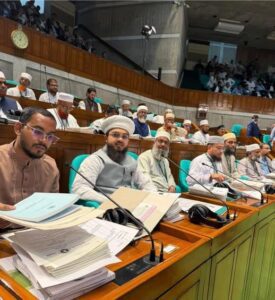
The Opening of Parliament: What the Nation Saw Live
The first session of Bangladesh’s 13th National Parliament was broadcast live, allowing citizens across the country to watch the proceedings as they unfolded.
The session began with a recitation from the Holy Quran. Above the Speaker’s chair, the Kalima—the Islamic declaration of faith—has been placed, introducing a visible symbolic element within the parliamentary chamber.
Bangladesh is home to people of many faiths. In earlier parliamentary traditions, important national events sometimes included readings from different religious scriptures. In this session, however, only the Islamic holy text was recited.
This development has renewed discussion about the growing presence of religious symbolism within the parliamentary setting.
Where Was the Liberation War?
For many observers, the most notable issue lies elsewhere.
Although the session began during the month of Bangladesh’s independence, there was no specific remembrance of the Liberation War, its martyrs, or the freedom fighters during the opening proceedings.
The state of Bangladesh emerged through the Liberation War of 1971, a struggle led by the country’s founding leader, Sheikh Mujibur Rahman.
Throughout the country’s parliamentary history, the Liberation War has frequently been remembered or honored during important national and parliamentary occasions. The absence of such reference during the opening of the 13th Parliament has therefore drawn the attention of many political observers.
Controversy Over the Condolence Motion
Parliamentary tradition usually includes the adoption of condolence motions in the first session to honor notable individuals who have recently passed away.
However, debate has emerged regarding the selection of some of the names mentioned. Critics argue that individuals connected to political circles associated with those convicted of war crimes were remembered, while the martyrs and historic leadership of the Liberation War did not receive comparable emphasis.
The issue of war crimes from 1971 remains one of the most sensitive chapters in Bangladesh’s political history. As a result, these symbolic choices at the start of the parliamentary session have intensified political debate.
A New Political Reality
The 13th National Parliament is dominated by the Bangladesh Nationalist Party, with Tarique Rahman emerging as the leader of the house.
The opposition includes Bangladesh Jamaat-e-Islami, a party that has long been part of the country’s political landscape and has historically been at the center of debates surrounding the events of 1971.
The political relationship between BNP and Jamaat-e-Islami is not new. In different periods of Bangladesh’s history, the two parties have formed alliances that played important roles in governing the country.
The symbolic features seen during the opening session of the new parliament have once again brought this political equation into public discussion.
The Constitution and the Character of the State
Bangladesh’s 1972 Constitution established four fundamental principles: nationalism, socialism, democracy, and secularism.
In later political periods, Islam was introduced as the state religion. Subsequent constitutional amendments also restored secularism as one of the core principles of the state.
Within this dual constitutional framework, the growing visibility of religious symbolism in parliament has prompted an important question: could Bangladesh gradually be moving toward a different interpretation of state identity?
Does Parliament Represent Everyone?
A national parliament is expected to reflect the diversity of a country. It is a forum where different political views, cultures, and religious identities find representation.
Bangladesh itself is a pluralistic society. Alongside Muslims, millions of Hindus, Buddhists, Christians, and people of other faiths live in the country.
In such a context, if the symbolic environment of parliament increasingly highlights one religious identity, some observers believe it may raise questions about the inclusive character of the state.
Final Thoughts
The opening of the 13th National Parliament marks the beginning of a new political chapter in Bangladesh.
For some, these developments simply reflect changing political realities. For others, they represent a symbolic shift away from the Liberation War–based ideals upon which the country was founded.
The legacy of the Liberation War, the constitutional principle of secularism, and the pluralistic nature of Bangladeshi society remain central pillars of the state.
Ultimately, the course taken by this parliament—through its legislation, governance, and constitutional decisions—will determine whether Bangladesh continues along the path shaped by its founding ideals or moves toward a different political direction.