
Bangladesh’s approaching 13th parliamentary election is unfolding against a striking absence of public enthusiasm, with a growing boycott movement cutting across prisons, expatriate communities, and large segments of the electorate. From urban neighborhoods to detention facilities, a single refrain has come to dominate political conversation: “No boat, no vote.”
With the election just days away, streets that would traditionally be filled with campaign rallies and voter mobilization efforts remain subdued. Instead, the interim administration led by Nobel laureate Dr. Muhammad Yunus faces mounting criticism over what opponents describe as a one-sided electoral process, deepening public distrust, and an aggressive propaganda campaign by government-aligned media outlets.
Adding a new dimension to the controversy, claims circulated in several outlets that prominent detainees affiliated with the Awami League had cast postal ballots from prison. The names cited included former prime ministerial adviser Salman F Rahman, former ministers Anisul Huq, Rashed Khan Menon, Hasanul Haq Inu, and former ICT state minister Junayed Ahmed Palak. Those claims unraveled within hours.
A handwritten note attributed to Palak, which circulated widely on social media from inside prison, directly rejected both the legitimacy of the interim government and the election process. In the note, Palak said that neither he nor others had voted and urged the public to stay away from the polls.
“Even if I starve to death in jail, I will not vote,” he wrote, calling the election illegal and invoking the political legacy of Bangabandhu Sheikh Mujibur Rahman to frame the boycott as an act of resistance.
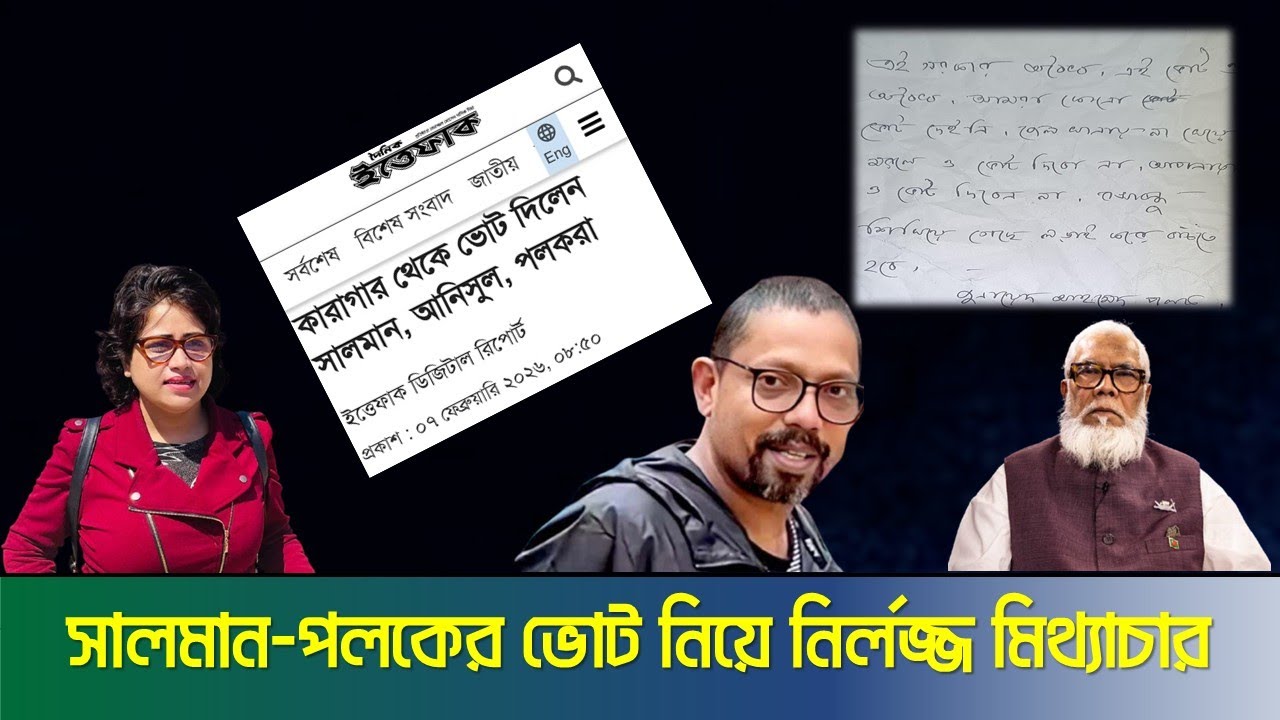
Official prison authorities moved quickly to deny the media reports. Speaking on Saturday evening, Assistant Inspector General of Prisons (Development and Media) Md. Jannat-ul-Farhad told vernacular newspaper, Daily Kalbela, that the reports were false.
“The news that former adviser Salman F Rahman, Anisul Huq, Junayed Ahmed and other VIP prisoners registered or voted by postal ballot is not true,” he said. “We did not provide such information. They did not even register for postal voting.”
According to data released by the Directorate of Prisons, voter participation among detainees has been overwhelmingly low. Of approximately 85,000 inmates nationwide, only 5,940 applied for registration, and just 4,538 ultimately cast ballots through the special postal voting process that began on February 3 and concluded on February 7, with a one-day extension. That means roughly 93 percent of prisoners declined to vote.
Prison officials cited administrative and practical reasons for the low registration rate, including the absence of national identity cards and concerns that registering inside prison would prevent inmates from voting later if they were released on bail. Yet lawyers representing detainees offered a more political explanation.

Farzana Yasmin Rakhi, counsel for several Awami League defendants, said a large number of prisoners are affiliated with a party barred from contesting the election. “With the Awami League absent from the race, people see no reason to participate,” she said. “Many prisoners are Awami League leaders or activists. They are asking—who would they vote for?”
The boycott extends far beyond prison walls. Despite more than 10 million Bangladeshis living abroad, only 767,188 registered for postal ballots. Of those, roughly 250,000 did not ultimately vote. Government figures also show that female participation among expatriate voters stands at just 6 percent. Compounding the controversy, logistical failures led to 12,170 ballots being returned undelivered to Bangladesh by February 7, costing the Election Commission more than 8.5 million taka.
These figures have intensified scrutiny of the Election Commission of Bangladesh, which has defended the process while acknowledging operational shortcomings. Critics argue that the low turnout—among prisoners, expatriates, and the general population—reflects not apathy, but rejection.
Political tensions have been further inflamed by opposition leaders’ conduct following the custodial death of former lawmaker Ramesh Chandra Sen in Thakurgaon. The visit by Mirza Fakhrul Islam Alamgir, secretary general of the Bangladesh Nationalist Party, to Sen’s home drew criticism from Awami League supporters, who accused BNP leaders of exploiting the tragedy after what they describe as politically motivated prosecutions. Jamaat-e-Islami candidates also faced accusations of staging symbolic gestures of sympathy while backing an electoral process widely seen as exclusionary.
For many Awami League supporters, the current climate is inseparable from the events of the past year and a half, marked by mass arrests, violent attacks, property destruction, and the demolition of historic party landmarks, including the Bangabandhu Memorial at Dhanmondi 32. BNP leaders have publicly claimed credit for leading the campaign against Awami League activists, further hardening perceptions that the election is taking place amid systematic intimidation.
The interim government’s vision of holding what it has called a “historic” election without the country’s largest political party is now facing international skepticism. Observers note that an election engineered around exclusion risks undermining its own credibility. The boycott campaign, amplified by Awami League figures at home and abroad, has become a defining feature of the political moment.
Former prime minister Sheikh Hasina and her son Sajeeb Wazed Joy have both publicly urged citizens to reject what they describe as a staged vote, framing non-participation as a defense of democratic legitimacy rather than disengagement.
As Bangladesh stands on the threshold of its 13th parliamentary election, the debate has shifted from who will win to whether the process itself can command moral or political authority. For millions who trace their political identity to the Liberation War and the ideals of independence, the boycott is being cast not as abstention, but as a statement about sovereignty, dignity, and the meaning of democracy itself.


