
WASHINGTON, DC — Senior U.S. foreign policy analysts and Bangladeshi political figures warn that Bangladesh’s evolving political landscape is drifting toward instability as the country prepares for a highly contested general election scheduled for February 12, 2026.
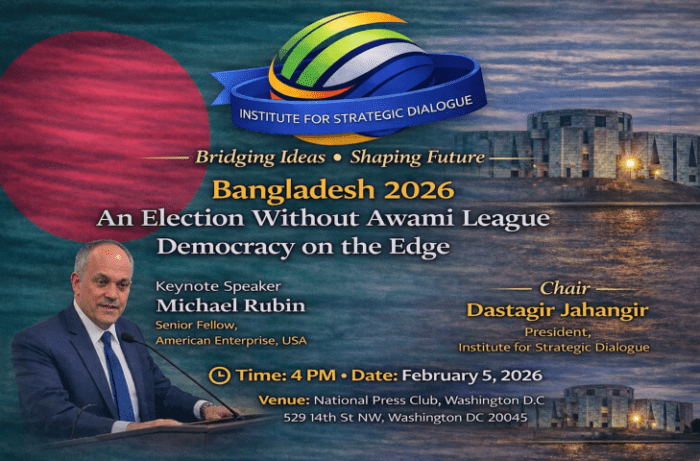
At a policy dialogue hosted by the Institute for Strategic Dialogue (ISD) at the National Press Club on February 5, 2026, American Enterprise Institute senior fellow Michael Rubin said the decision to bar the Awami League — Bangladesh’s largest and historically dominant political party — from electoral participation reflects uncertainty about defeating it in a genuinely free and competitive contest, rather than any clearlegal necessity.
Rubin cautioned that the growing reliance on legal and administrative measures to sideline political rivals may offer short-term control but risks long-term damage to democratic institutions and political stability. His remarks were made in the context of Bangladesh’s turbulent transition following mass protests in 2024 that led to the ouster of Prime Minister Sheikh Hasina and the formation of an interim government headed by Nobel laureate Dr.Muhammad Yunus.
Analysts at the forum said the current approach has intensified political polarization, with key political actors marginalized and legal tools applied unevenly. Critics argue that excluding the Awami League from the electoral process, alongside administrative crackdowns and criminal cases against its leaders, signals an avoidance of genuine electoral competition rather than impartial enforcement of the law. These developments have fueled growing international debate over whether Bangladesh’s democratic progress is being undermined.
Speakers at the forum noted that the interim authorities and their political allies are reshaping the country’s political landscape through exclusion rather than competition, raising concerns about the credibility of the upcoming election.
“Using legal and administrative tools to push rival political forces out of the field is not new in Bangladesh,” Rubin said during the discussion. “But in the present context, the scale and intent of these actions suggest a deeper anxiety about competing in an inclusive and participatory electoral process.”
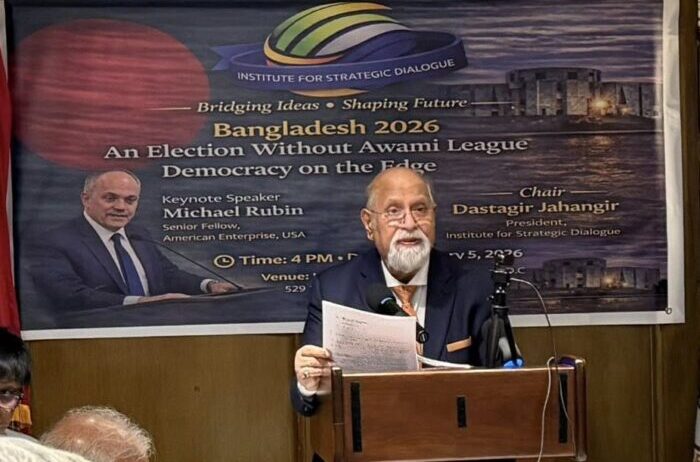
He added that suppressing political competition may deliver temporary advantages but often produces long-term consequences by weakening state institutions, eroding public trust, and destabilizing democratic systems.
Interim rule and rising international concern
Bangladesh has been under interim rule since August 2024. While the transitional authorities pledged reforms, accountability, and political normalization, critics say the political environment has instead become more restrictive. Opposition parties — particularly the Awami League — face legal bans, arrests, and administrative barriers that effectively exclude them from electoral participation.
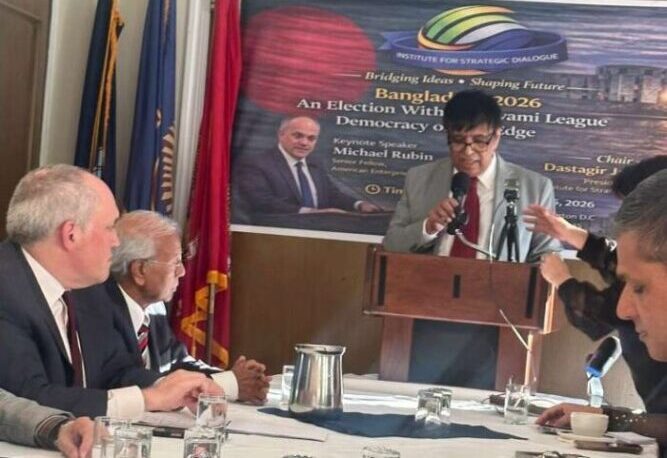
Former foreign minister A K Abdul Momen warned that the domestic political deadlock is already affecting Bangladesh’s diplomatic relations and global image.
“When political uncertainty becomes prolonged, it does not remain an internal matter,” Momen said. “It directly impacts foreign relations, investor confidence, and international cooperation. The longer the impasse continues, the greater the economic and diplomatic costs.”
Diplomats and analysts attending the forum said Bangladesh’s international partners are increasingly focused on whether the upcoming election will be inclusive, credible, and reflective of the electorate’s will — standards widely viewed as difficult to meet without the participation of major political forces.
Momen further cautioned that continued political paralysis could deter foreign investment and strain Bangladesh’s diplomatic ties, while human rights activist Dr. Dilip Nath said civil liberties, the rule of law, and minority protections are under growing strain.
Warnings on constitutional continuity and social cohesion
Veteran freedom fighter Dr. Nurun Nabi stressed that Bangladesh’s political crisis cannot be separated from its foundational principles. He underscored the importance of the spirit of the 1971 Liberation War, secular governance, and constitutional continuity.
“Politics built on division and exclusion weakens society from within,” he said. “When violence and polarization replace dialogue, the damage to the state structure is deep and lasting.”
Dilip Nath echoed those concerns, warning that the current political climate poses serious risks to civil liberties and democratic safeguards.
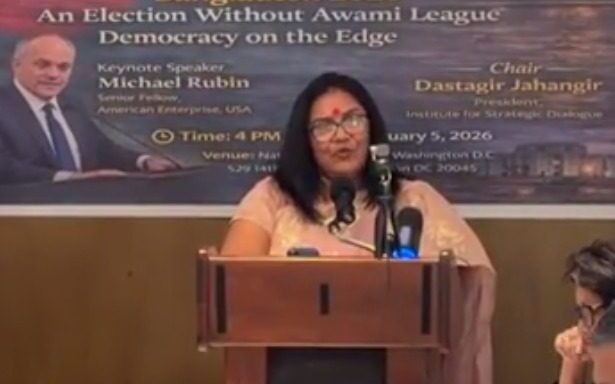
“Human rights, freedom of expression, and legal protections are under unprecedented strain,” Nath said, calling for an end to what he described as a culture of intimidation, harassment, and politically motivated cases used to silence dissent.
Polarization across institutions and streets
Other speakers highlighted what they described as a sharp resurgence of political polarization across Bangladesh’s power centers — from the administration and law enforcement agencies to the streets. Allegations of politically driven arrests, legal harassment, and reprisals against opponents were repeatedly raised during the discussion.
Participants also expressed concern over election administration, freedom of expression, minority security, and the overall law-and-order situation, warning that unresolved tensions could further erode public confidence in democratic processes.
The dialogue was moderated by ISD Director and journalist Shaban Mahmud, along with Executive Director Shayla Ahmed Lopa. Participants included American Security Analyst Jamal Hasan, A figure who helped shape public opinion during the Liberation War Greg Rushford, Zia Karim, Abdul Qader Mia, among others. The session concluded with closing remarks from ISD Vice President and senior journalist AZM Sazzad Hossain Sobuj.
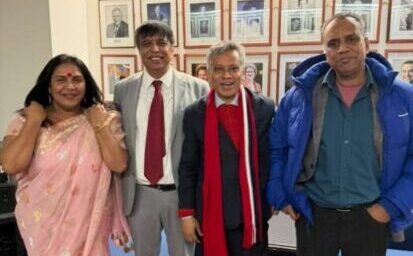
Journalists from India, Pakistan, South Korea, and the United States attended the event, alongside numerous Bangladeshi-American community leaders, underscoring the international stakes tied to Bangladesh’s political future.
As Bangladesh approaches a pivotal election under interim rule, analysts at the Washington forum warned that lasting stability will depend not on exclusion or administrative control, but on restoring political competition, public trust, and constitutional norms.


