
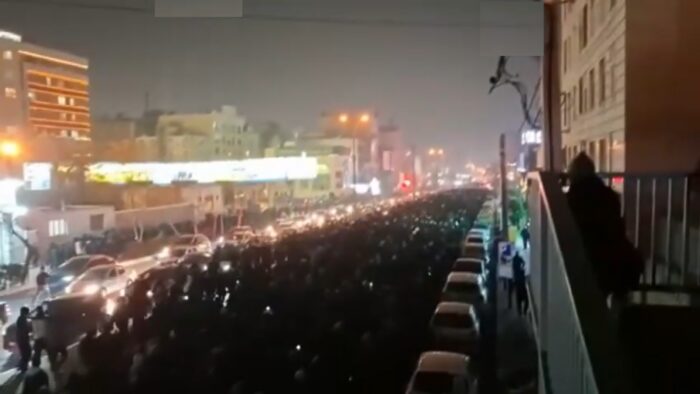
Tehran and other Iranian cities were rocked by large-scale anti-government protests on Thursday as public anger over economic collapse, political repression, and security force violence spilled into the streets, posing one of the most serious challenges to Iran’s ruling establishment in years.
The demonstrations erupted amid soaring inflation, a plunging national currency, and widening distrust in state institutions. Almost immediately after protests began in the capital, authorities cut internet access and telephone services across large parts of the country, a move digital rights monitors say often precedes a violent crackdown.
Footage verified by international media showed crowds blocking roads, setting fires, and chanting slogans against the Islamic Republic. In Tehran, demonstrators were heard shouting, “This is the last battle, Pahlavi will return,” echoing calls by exiled opposition figures for mass mobilization.
Some protesters appeared to be responding to appeals by exiled Crown Prince Reza Pahlavi, who on Thursday urged Iranians to confront the authorities. Writing on X, he called on citizens to “take to the streets and, as a united front, shout your demands,” concluding his message with the words, “Rise Iran!”
The unrest prompted a sharp response from Washington. Speaking Thursday during a radio interview with Hugh Hewitt, U.S. President Donald Trump warned Tehran against using lethal force. “I have let them know that if they start killing people, which they tend to do during their riots, we’re going to hit them very hard,” Trump said, reiterating threats of military action if protesters are killed.
Economic despair at the heart of the protests
The current wave of unrest was triggered last week when shopkeepers in Tehran’s historic Grand Bazaar protested what they described as disastrous economic policies. Tensions escalated after Iran’s central bank ended a program allowing some importers access to subsidized U.S. dollars, prompting immediate price hikes.
Overnight, the cost of basic goods such as cooking oil and chicken surged, while some products vanished from shelves entirely. The resulting shock pushed many bazaar merchants—traditionally seen as loyal to the Islamic Republic—to shut their shops, a dramatic and politically loaded move in Iran’s history.
“This feels different because it’s about people’s buying power, and people really can’t afford anything,” said a 30-year-old Tehran resident who spoke anonymously to international media for fear of reprisals. “Prices keep going up almost hour-by-hour at this point, but how it ends no one really knows. Everyone feels worried.”
In an attempt to calm public anger, President Masoud Pezeshkian announced modest cash payments of roughly $7 per month to low-income citizens. In a televised address on Monday, he acknowledged the scale of the crisis, saying, “We should not expect the government to handle all of this alone,” while conceding that handouts alone could not resolve the country’s economic collapse.
Protests spread nationwide, slogans turn political
What began as localized economic protests has rapidly evolved into a nationwide movement with explicit political demands. Demonstrations have been reported in more than 100 cities over the past 11 days, including restive western provinces such as Ilam and Lorestan, where poverty and ethnic tensions run deep.
In these regions, crowds openly challenged Iran’s supreme leader, chanting “Death to Khamenei” and “This is the year of blood, Seyyed Ali is going to fall,” referring to Ayatollah Ali Khamenei, who holds ultimate authority over Iran’s political and religious institutions.
In Mashhad, Iran’s second-largest city and Khamenei’s hometown, videos distributed by Reuters showed protesters lowering and tearing apart the national flag. Elsewhere, footage from Golestan province appeared to show a fire burning inside a government complex.
Iranian journalist and activist Masih Alinejad said the demonstrations have moved well beyond economic grievances. Speaking Thursday on CNN’s “The Lead” with Jake Tapper, she said, “This is very clear that they’re saying that this regime can no longer be reformed. So they’re saying we want an end to the Islamic Republic.”
Describing the mood on the streets, Alinejad added, “I even smell the freedom. When people go to the streets, they show their face. They say that we have no fear because we have nothing to lose.”
Deaths, arrests, and information blackout
Human rights groups report a rapidly rising toll. The Norway-based Iran Human Rights NGO said Thursday that at least 45 protesters, including eight children under 18, have been killed since demonstrations began on December 28, 2025. The organization also reported that more than 2,000 people have been detained and hundreds injured.
“State forces have used live ammunition to suppress the protests and have carried out widespread, mass arrests in some cities,” the group said in a statement.
Iranian state-affiliated Fars News Agency, meanwhile, reported that 950 police officers and 60 members of the Basij paramilitary force have been injured, accusing “rioters” of using firearms and grenades. Iranian media have also reported that at least five security personnel, including two members of the Islamic Revolutionary Guard Corps, were killed.
Independent verification of casualty figures remains difficult due to sweeping communication blackouts. NetBlocks director Alp Toker said some Iranians are still managing limited online access through satellite connections.
“National blackouts tend to be the regime’s go-to strategy when deadly force is about to get used against protesters,” Toker said, explaining that the aim is “to prevent the spread of news of what’s happening on the ground and to limit international scrutiny.”
Why this moment is different
Analysts say the current unrest is the most significant since the 2022 protests sparked by the death of Mahsa Amini in morality police custody. This time, however, the involvement of bazaar merchants—historically powerful political actors—marks a crucial shift.
For decades, an alliance between bazaaris and Shiite clerics helped sustain the Islamic Republic. That same merchant class once provided the financial backbone for the 1979 revolution that toppled Iran’s monarchy. Their defiance now underscores the depth of the crisis confronting the state.
“These protests reflect overlapping economic, political, and social breakdowns,” said Arang Keshavarzian, an associate professor at New York University. “None of Iran’s political leaders have a blueprint to get Iran out of these crises,” he said, adding that “the only tool the Islamic Republic truly has left is coercion and force.”
A regime under strain
President Pezeshkian came to office promising relief for workers and the middle class, blaming sanctions, corruption, and unchecked money printing for Iran’s woes. More than a year later, both groups are struggling to survive amid worsening conditions, while the threat of renewed conflict with the United States and Israel heightens public anxiety.
Experts caution that despite the scale of the unrest, the absence of a unified opposition or clear alternative system makes immediate regime change unlikely. Still, the breadth and intensity of the protests highlight a profound legitimacy crisis.
As Keshavarzian noted, “Over the past 15 years, large segments of the population have lost trust in the regime and don’t believe it is able or willing to actually listen to them and address their grievances and interests.”
For Iran’s leaders, the protests present a stark dilemma: offer meaningful reforms in a system built on rigid control, or rely increasingly on force to maintain power in a society that appears to be running out of fear.


