
President Donald Trump sharply escalated tensions with Iran on Friday, declaring that the United States was prepared to act if Iranian authorities used lethal force against demonstrators protesting economic hardship, a statement that immediately drew fierce warnings from Tehran and raised fears of wider regional instability.
In a post published early Friday on his Truth Social platform, Trump said Washington would come to the aid of Iranian protesters if security forces killed civilians. “If Iran violently kills peaceful protesters, which is their custom, the United States of America will come to their rescue,” Trump wrote. “We are locked and loaded and ready to go.” The remarks were made as protests entered their sixth consecutive day, with reports of deaths, arrests, and violent confrontations continuing to surface across the country.
Protests fueled by economic collapse
The demonstrations erupted amid Iran’s deepening economic crisis, driven by soaring inflation, currency collapse, international sanctions, and years of domestic mismanagement. Iran’s currency recently fell to a historic low against the U.S. dollar on the unofficial market, while annual inflation exceeded 40 percent, eroding purchasing power and pushing millions further into hardship.
What began as protests by business owners and university students in major cities quickly spread to smaller towns and western provinces. Demonstrators chanted slogans such as “Death to the dictator” and “Iranians, raise your voice, shout out for your rights,” according to videos shared by rights groups, local media, and protesters on social media platforms.
State-affiliated Iranian media and human rights organizations have reported multiple fatalities during clashes between demonstrators and security forces, particularly in western cities such as Lordegan and Kuhdasht. Rights groups also reported deaths in other provinces, though Iranian state outlets disputed some accounts. Reuters said it could not independently verify all reports of unrest, arrests, or fatalities.
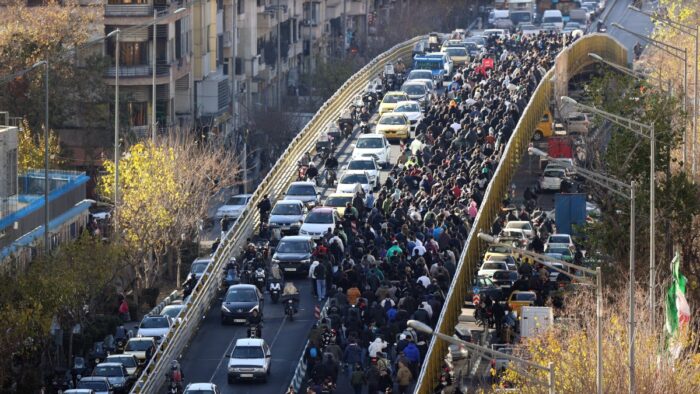
Iranian authorities acknowledged injuries among security personnel and said several police stations and government buildings were attacked. State television reported arrests in cities including Kermanshah, alleging that some detainees were involved in manufacturing petrol bombs or homemade weapons.
Iranian leadership issues stark warnings
Trump’s remarks triggered immediate backlash from Iran’s senior leadership. Mohammad Bagher Ghalibaf, the speaker of Iran’s parliament, warned that any U.S. intervention would have grave consequences. In a social media post, he said that “all American bases and forces across the entire region will be legitimate targets” if Washington interferes in Iran’s internal affairs.
An even stronger warning came from Ali Larijani, a senior adviser to Supreme Leader Ayatollah Ali Khamenei and head of Iran’s Supreme National Security Council. Writing on social media on Friday, Larijani said U.S. involvement would destabilize the Middle East and damage American interests.
“The American people should know — Trump started this adventurism,” Larijani wrote, adding that U.S. interference would put American troops across the region at risk. Iran maintains influence through allied groups in Lebanon, Iraq, Syria, and Yemen, several of which have previously targeted U.S. forces.
Iran’s Foreign Ministry spokesman Esmail Baghaei also dismissed Trump’s statement, accusing Washington of hypocrisy. In a statement posted on social media on Friday, Baghaei said Iranians would resolve their challenges through internal dialogue and would not permit foreign interference. He cited past U.S. actions, including sanctions, military strikes, and the 1988 downing of an Iranian passenger plane, as evidence that American claims of “saving the Iranian people” lacked credibility.
Trump’s comments tied to broader confrontation
Trump’s warning comes amid an already volatile backdrop in U.S.–Iran relations. Nearly six months earlier, the United States joined Israel in airstrikes on Iranian nuclear facilities, targeting sites linked to Tehran’s atomic program. Earlier this week, Trump met Israeli Prime Minister Benjamin Netanyahu, reiterating that Washington would back Israeli military action if Iran revived its nuclear or ballistic missile activities.
Trump said he had received intelligence suggesting Iran may be attempting to restart aspects of its nuclear program, though he offered no public details. Tehran has consistently denied seeking nuclear weapons, insisting its program is for peaceful purposes.
Israeli officials openly expressed support for the Iranian protesters. Several ministers posted messages on social media condemning Iran’s leadership and backing the demonstrations. In a video posted on X on Thursday, Israel’s minister of innovation, science and technology, Gila Gamliel, addressed Iranians directly, saying their protests were justified and expressing Israel’s support.
Protesters emboldened, risks heightened
Some protesters said Trump’s statement boosted morale but also raised expectations. A medical doctor in Iran’s northeastern Khorasan province, who identified himself only as Mojtaba for fear of retaliation, told journalists that Trump’s message had energized demonstrators and heightened international attention.
Analysts cautioned, however, that Trump did not specify what form U.S. support might take, and it remains unclear whether any concrete planning exists behind the rhetoric. U.S. officials have not announced military, diplomatic, or economic measures tied specifically to the protests.
Iran’s president acknowledges internal failures
Amid the unrest, Iran’s elected president, Masoud Pezeshkian, adopted a notably conciliatory tone. Speaking publicly on Thursday, before Trump’s warning, Pezeshkian acknowledged government responsibility for the crisis.
“We are to blame,” Pezeshkian said during remarks addressing the economic turmoil. “Do not look for America or anyone else to blame. We must serve properly so that people are satisfied with us. It is us who have to find solutions to these problems.”
Pezeshkian’s government has been pursuing limited economic liberalization, including loosening controls on currency exchange, a move that analysts say contributed to the sharp fall in the rial. While officials say dialogue with protest leaders is possible, rights groups reported that security forces had used live fire in some areas.
A familiar cycle with higher stakes
Iran’s clerical leadership has weathered repeated waves of unrest over the past two decades, often suppressing protests through heavy security measures and mass arrests. But observers say the current crisis is unfolding under more fragile conditions, with the economy under extreme strain, regional allies weakened, and tensions with the United States and Israel at a recent peak.
Trump’s declaration that the U.S. is “locked and loaded,” even without operational details, has injected a new level of uncertainty into an already combustible situation. Diplomats and analysts warn that miscalculation — by protesters, Iranian security forces, or foreign powers — could rapidly turn a domestic crisis into a broader regional confrontation.


