
News Analysis
When the news broke in London that Tulip Siddiq — a sitting British Member of Parliament, a former UK minister, and niece of Bangladesh’s exiled Prime Minister Sheikh Hasina — had been sentenced to two years in prison by a Dhaka court, the shock rippled far beyond Westminster. It spread across oceans, dominating headlines from BBC and CNN to Reuters, AP, AFP, DW, and The Guardian. The verdict — delivered in absentia, without defense lawyers present, and without any formal notice ever reaching Siddiq — became a global test case for the credibility of Bangladesh’s interim government and the integrity of its judiciary.
But the story began long before the courtroom doors opened. It is tethered to Bangladesh’s political collapse in August 2024, the violent ouster of Sheikh Hasina, and the rapid consolidation of power by an unelected interim administration under Nobel laureate Muhammad Yunus. And now, with Tulip Siddiq thrust into the center of a legal storm that many describe as political retribution, the world is watching.
The fall of an elected government, the rise of an interim regime, and a high-profile British MP standing conviction in a Bangladeshi tribunal — together they form a narrative that is as much about Bangladesh’s fragile democracy as it is about the fate of one woman who insists she has “done nothing wrong.”
This is the story of how Tulip Siddiq’s conviction became a mirror reflecting the deeper crisis inside Bangladesh — a crisis now exposed under a global spotlight she never sought.
A Shattered Political Landscape
In early August 2024, Bangladesh witnessed one of the most tumultuous transitions in its history. A student-led movement, swiftly infiltrated and overwhelmed by hardline Islamist groups and elements within the armed forces, toppled Sheikh Hasina’s elected government. With the Awami League removed from power and ultimately banned from political participation, the country descended into a political vacuum.
A sweeping legal offensive followed. Sheikh Hasina herself — who had governed Bangladesh longer than any leader in the country’s history — was charged with crimes ranging from corruption to genocide for last year’s protest crackdown. Trials were launched against her children, her sister Sheikh Rehana, and, eventually, her British niece Tulip Siddiq.
The message to Bangladesh’s political class was unmistakable: the Hasina family would face the full force of the interim state.
But in London, Tulip Siddiq appeared blindsided. As a Labour MP for Hampstead and Highgate, she maintained she had no involvement in Bangladeshi politics, held no Bangladeshi passport, and had received no summons, no legal notice, no charge sheet — not even a phone call.
“I’m absolutely baffled,” she told the BBC. “I’ve still had no contact whatsoever from the Bangladeshi authorities… I’m not difficult to find, I’m a parliamentarian.”
What she learned about the case, she said, she learned from the media.
A Verdict Without a Defendant
On December 1, a Dhaka court declared Siddiq guilty of improperly influencing Sheikh Hasina to allocate land plots to her mother, Sheikh Rehana, and her siblings. The judge sentenced Tulip to two years in prison and imposed an $820 fine. Her mother received seven years. Her aunt — Sheikh Hasina herself — received five years in the same case.
All were tried in absentia.
None was represented in court.
A lawyer who attempted to defend them reported being threatened and placed under house arrest — a claim highlighted in The Guardian’s coverage.
Prosecutors alleged that Tulip used her “special power” as a UK MP to pressure Hasina, but no messages, call records, or documentary evidence were presented in court. The case rested on statements from two former officials.
To London, the situation seemed surreal.
Tulip called the decision “flawed and farcical from the beginning to the end” and described the process as a “kangaroo court.”
“I feel like I’m in some sort of Kafkaesque nightmare,” she told the BBC.
She insisted she has not been a Bangladeshi citizen since childhood and has never had a national ID card, yet was prosecuted as if she held one.
“A Mockery in the Name of Justice” — Expert Voices Speak Out
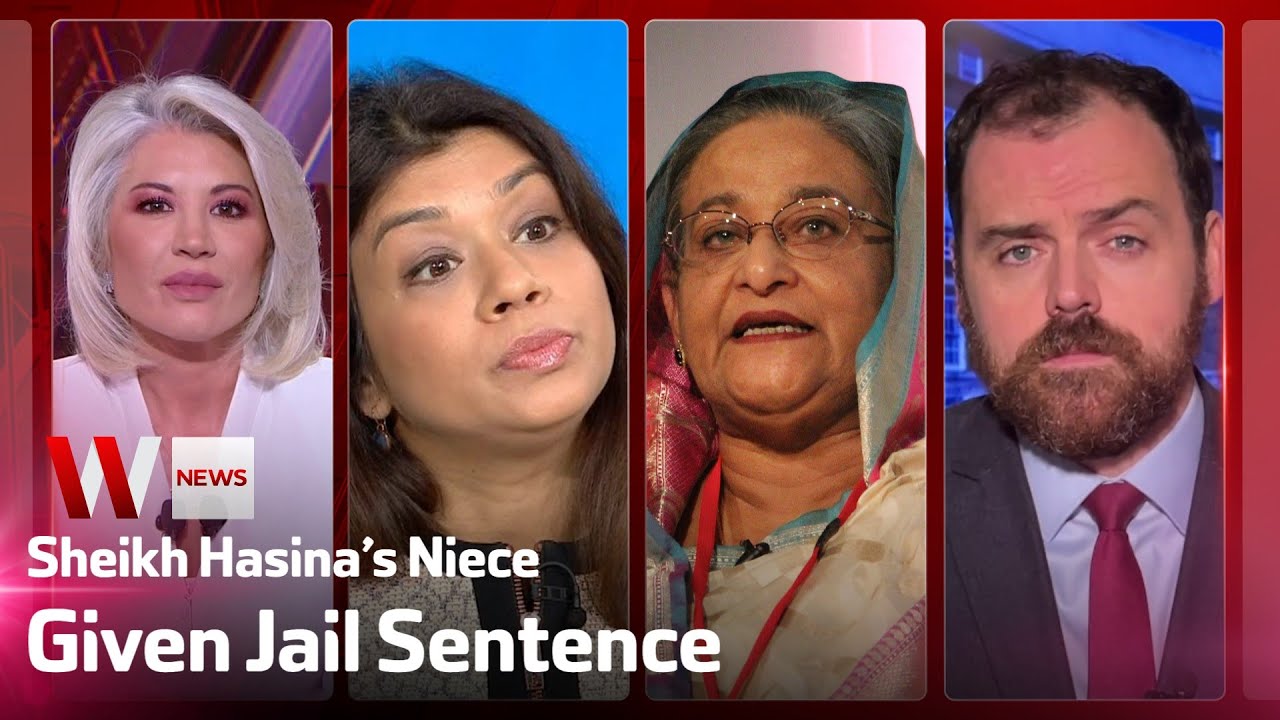
Two Bangladeshi experts interviewed for The Voice offered scathing assessments of the case.
Advocate Parvez Hashem, lawyer and human rights defender, said:
“There is credible reason to believe that the trial and verdict are politically motivated and lack legitimacy. In reality, it is a mockery in the name of justice.”
He noted that the prime minister did not need Tulip’s input to allocate land to her own family, calling the allegation “laughable” and unsupported.
Freedom Fighter Tajul Imam added:
“There is no reason to believe the allegation. It appears unfounded.”
He warned that such verdicts “will give a bad message to the world about the judiciary of Bangladesh” and risk straining UK–Bangladesh ties.
Their concerns mirror the reactions of global media outlets.

Global Media Reaction: A Rare Consensus
Major international news organizations have covered the verdict intensively, raising concerns about due process and political motivation.
BBC
Reported Tulip’s account that she had received “absolutely no summons” and described the process as “deeply unfair.”
CNN
Noted the court’s sentencing of both Hasina and Siddiq in a corruption case tied to a land allocation scheme.
Reuters
Highlighted Siddiq’s denunciation of the trial as “flawed and farcical” and noted that the UK has no extradition treaty with Bangladesh.
Associated Press (AP)
Reported that the judge accused Siddiq of “corruptly influencing” her aunt, while Siddiq denied receiving any formal notice and disputed being tried as a Bangladeshi citizen.
AFP, DW, Al Jazeera, The Guardian, The Independent, ITV, Sky News, Washington Post
All carried in-depth coverage of the conviction, placing it within the broader context of Bangladesh’s post-Hasina legal purge and the interim government’s aggressive prosecution of the Hasina family.
The Guardian
Noted that prosecutors did not present the messages they claimed existed, and that no defense lawyers were present because the defendants boycotted the trial.
The tone across these outlets has been consistent: skepticism, discomfort, and warnings about the impact on Bangladesh’s international standing.
Inside the Courtroom: A Legal Void
Observers note several structural problems with the trial:
- No defense counsel
- No summons or charge sheet served to the accused
- No documentary evidence presented
- Reliance on hearsay testimonies
- Use of in absentia proceedings without safeguards
- Rapid succession of cases against one political family
Human rights organizations and British legal experts have called the process “artificial, contrived and unfair,” according to correspondence delivered to Bangladesh’s High Commission in London.
Political Context: A Broader Purge of the Hasina Family
The conviction of Tulip Siddiq is part of an expanding series of cases brought after Sheikh Hasina’s removal. These include:
- a conviction for crimes against humanity, including allegations of genocide,
- a recent 21-year corruption sentence,
- five-year terms for her son and daughter,
- and the current case targeting her sister and niece.
All were tried in absentia.
None of the defendants was given access to defense representation.
Siddiq herself has said she believes she is “collateral damage” in Bangladesh’s political struggle.
Diplomatic Fallout: A Growing Rift
British reactions have been measured but firm.
The Labour Party stated it “cannot recognise this judgment” because Siddiq was denied a fair legal process.
UK ministers have reaffirmed that Siddiq will continue to serve her constituents and that the case is viewed as a political matter rather than a legitimate legal one.
Bangladesh intends to notify the UK government of the verdict, but without an extradition treaty, Britain is under no obligation to act.
Analysts warn the case could damage UK–Bangladesh relations, particularly if Dhaka seeks further legal action against a British MP.
A Human Story in a Time of Political Upheaval
Though Tulip Siddiq has lived in Britain for decades, her name — and those of her mother and aunt — are now at the center of a legal and political drama unfolding thousands of miles away.
As global media continue to question the legitimacy of the verdict and as international legal voices express alarm, the case has become a symbol of the turbulence inside Bangladesh following Sheikh Hasina’s ouster.
For Bangladesh, it raises profound questions about judicial independence.
For Britain, it presents a delicate diplomatic challenge.
For Tulip Siddiq, it is a deeply personal ordeal rooted in a political conflict she has never participated in.
And for the world, it has become a window into the state of Bangladesh’s democracy.


