
Dhaka, Bangladesh — The arrest of renowned Baul singer Abul Sarkar on blasphemy charges has ignited a new wave of cultural and political unrest across Bangladesh, with civil society figures, artists, academics, and rights groups warning that religious extremism is sharply rising under the current interim administration.
Sarkar, a celebrated mystic minstrel known for his spiritual folk performances, was detained on November 20 in Madaripur after an imam filed a complaint accusing him of making derogatory remarks about Islam during a live performance. Police charged him under provisions relating to incitement, religious sentiment, and public disorder.
What followed his arrest, however, has triggered far deeper concern.
Islamist Mob Violence Escalates
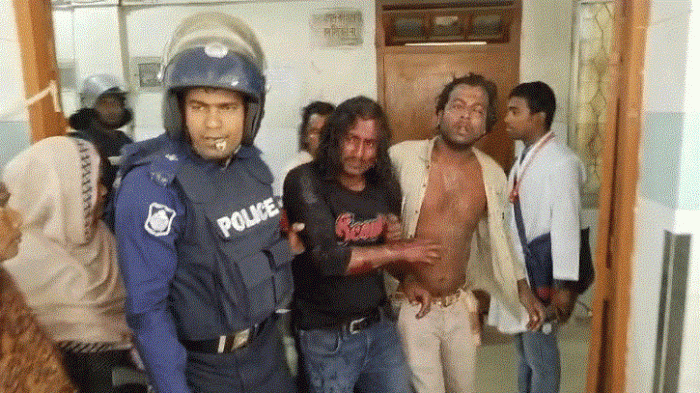
Within days, mobs identifying themselves as Tawhidi Janata attacked fellow Baul singers during a street rally calling for Sarkar’s release. At least four artistes were seriously injured near the northern edge of Dhaka, prompting widespread condemnation.
Tawhidi Janata—a loosely organized but increasingly assertive Islamist network—has been linked to multiple attacks on cultural gatherings, Sufi shrines, and religious minorities since the ouster of Sheikh Hasina’s elected government in August 2024.
Cultural scholars note that Baul traditions, rooted in syncretic Bengali spirituality, have long been disliked by hardline groups who reject their liberal, humanistic worldview.
“These attacks are not isolated incidents. They are part of a broader ideological purge,” said one Dhaka University academic involved in recent protests.
Civil Society Denounces Growing ‘Religious Fascism’
On Monday, over 250 prominent Bangladeshi citizens released a joint statement warning that extremist groups were expanding their influence while state institutions remained “silent or complicit.”
“In the period following the July mass uprising, religious extremism has surged,” the statement said. “A particular group has emerged as a self-appointed guardian of Islam and is carrying out a nationwide purge.”
The signatories — including pro-Yunus government public figures such as Prof. Anu Mohammad and Prof. Salimullah Khan, both critics of the previous Awami League government — listed a series of alarming developments:
- Destruction of more than 200 Sufi shrines
- Labeling individuals as murtad or kafir
- Exhuming and burning bodies
- Forcibly shaving Bauls and fakirs
- Harassment of women for dress and movement
- Disruption of cultural events, fairs, dance and theatre performances
- Vigilante-style intimidation in universities and localities
They warned that the pattern reflected an “attempt to eradicate dissenting voices and cultural diversity.”
Rights Groups Express Alarm
Leading NGO Ain o Salish Kendra (ASK) described the events as a grave threat to freedom of expression and cultural heritage.
Transparency International Bangladesh also issued a statement calling the situation “a dangerous rise in hostility toward religious harmony.”
Poet and Islamic activist Farhad Mazhar, himself a vocal critic of the former Awami League government, publicly condemned the arrest, saying, “Arresting him means arresting me. I will not accept this.”
Mazhar’s participation is especially noteworthy — his spouse is a member of the advisory council of interim government chief Professor Muhammad Yunus, raising questions about ideological fault lines even within the administration’s extended circle.
Growing Fears of State Inaction
Critics accuse the interim government of failing to rein in vigilante groups. Several academics argue that security agencies have neither acted swiftly nor shown willingness to prosecute perpetrators.
“Law enforcers are not taking effective steps,” the civil society statement declared. “Instead, they are detaining victims or attacking survivors under fabricated charges.”
Prominent lawyer Sara Hossain also told The Voice that authorities were too quick to accept cases against artists while ignoring violence committed by extremist mobs.
“There is a serious question about selective enforcement,” she said.
Government’s Conflicted Response
Cultural Affairs Adviser Mostofa Sarwar Farooki acknowledged that the situation was “extremely delicate and sensitive” and insisted that the Home Ministry was “handling it responsibly.”
But Farooki also argued that repression of Bauls was not new, noting similar incidents under previous administrations. Critics, however, argue that such remarks minimize the urgency of current attacks, which many see as unprecedented in scale and boldness.
Interim government spokesperson Shafiqul Alam condemned the mob assault but offered limited detail on specific measures being taken.
Local media expressed skepticism. An editorial by The Business Standard described Farooki’s comments as “a poor defense,” noting that “condemnation without action rings hollow—especially when attackers operate publicly and with apparent impunity.”
A Broader Cultural Crisis
Bangladesh’s Baul tradition — recognized by UNESCO as an intangible cultural heritage — represents one of South Asia’s oldest forms of syncretic spiritual practice. The rise in attacks has stirred anxiety among cultural historians who fear an existential threat to the country’s pluralistic identity.
“This is not just about one singer,” said a senior performer at a Baul demonstration. “This is about the soul of Bangladesh.”
A Nation Searching for Balance
The ongoing turmoil reflects deeper tensions over Bangladesh’s cultural direction since the political transition of 2024–2025. Artists, intellectuals, and activists warn that the country stands at a crossroads where religious militancy, institutional weakness, and political uncertainty are converging dangerously.
Whether the government can restore public confidence and protect one of Bangladesh’s most cherished cultural traditions remains to be seen.
For now, the Baul community — symbolizing centuries of spiritual humanism — finds itself at the center of a battle over the nation’s identity.


