
A quiet but steady revival of a World War II–era airbase in northern Bangladesh, a short flight from India’s vulnerable Siliguri Corridor, is beginning to reshape military assessments on both sides of the border — raising questions about intent, deterrence and the risk of miscalculation in one of South Asia’s most sensitive regions.
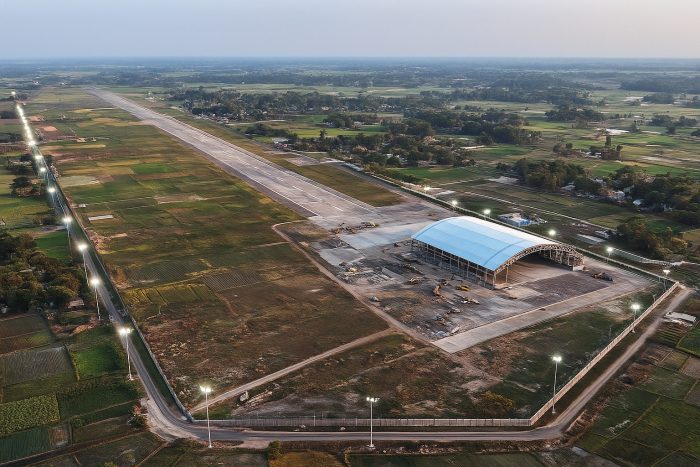
Satellite imagery, local reporting and defense analysts say Bangladesh’s armed forces have accelerated work at BAF Station Lalmonirhat, constructing a new hangar capable of hosting multiple aircraft, installing floodlighting along perimeter fencing and increasing round-the-clock security patrols across the 1,166-acre complex.
The airbase lies less than 20 kilometers from India’s West Bengal border and roughly 130–140 kilometers from the Siliguri Corridor, the narrow land bridge that connects mainland India to its eight northeastern states.
Indian security and intelligence officials met in the nearby city of Siliguri on Nov. 22 to assess the implications of the renewed activity, according to reporting by India Today. New Delhi has simultaneously moved to reinforce its own posture, establishing three new army garrisons in West Bengal, Assam and Bihar.
The developments have created what regional analysts describe as a security dilemma in a geography where even modest military upgrades carry outsized political significance.
Old Airfield, New Ambitions
Built in 1931 during British rule, Lalmonirhat once hosted one of Asia’s largest airfields. Allied forces used it during the Burma campaign before it fell into disuse after partition and the independence of Bangladesh. Today the base is jointly operated with the Bangladesh Aviation and Aerospace University. There are no scheduled civilian flights.
That low profile began to change earlier this year.
Regional defense reporting by Northeast News and other outlets says a large hangar has been erected on the western segment of the airfield at Haribhanga village. The structure, now receiving final floor work, is believed capable of hosting medium-lift aircraft, helicopters, unmanned aerial vehicles or even fighter jets — depending on future procurement.
Floodlights have been installed along stretches of perimeter fencing to increase visibility at night. Bangladesh Air Force personnel now conduct continuous patrols, often using bicycles to move quickly across the 4-kilometer runway.
On Oct. 16, Bangladesh Army chief Gen. Waker-uz-Zaman toured Lalmonirhat and the smaller Thakurgaon airfield to review construction progress. His visit coincided with a trip by a team of Indian Military Intelligence officers, according to the defense community platform Bangladesh Military Forces.
Bangladesh’s government has not provided detailed public information about the airbase’s intended role. Officials routinely emphasize Dhaka’s sovereign right to modernize military infrastructure, framing the construction as part of broader efforts to expand air mobility, disaster-response capacity and border security.
India’s Narrowing Neck
The airbase’s revival is unfolding in a strategically hyper-sensitive neighborhood.
The Siliguri Corridor, often referred to as India’s “Chicken’s Neck,” narrows to as little as 22–35 kilometers between Nepal and Bangladesh. It carries highways, rail lines, pipelines and military logistics linking India to its northeastern states and to borders with China and Myanmar. Indian planners have long regarded it as a potential point of vulnerability in any regional conflict.
A functioning Bangladeshi airbase so close to the corridor complicates that calculus, analysts say, especially if Lalmonirhat in the future hosts surveillance drones, fighter aircraft or equipment supplied by external partners.
Indian defense commentary has increasingly spotlighted reports — unconfirmed by either Dhaka or Beijing — alleging Chinese technical interest in the site. Articles in publications such as The Economic Times and Indian strategic outlets have warned that any Chinese role would be viewed as part of a broader effort to expand presence along India’s periphery.
Bangladesh maintains substantial defense ties with China, including naval and air acquisitions, even as India remains one of its largest development and diplomatic partners. The Lalmonirhat expansion comes at a time of high India-China tension along their contested Himalayan border, adding further sensitivity.
India has responded by strengthening its own posture. According to India Today and local coverage, three new army bases have been established at Chopra (West Bengal), Bamuni (Assam) and Kishanganj (Bihar). Authorities have also introduced tighter controls on drone usage and coordinated multi-agency drills in the corridor.
Some politicians have used stronger language. Assam’s chief minister earlier warned of retaliation if the corridor were threatened — comments that drew attention but not an official response from Dhaka, as reported by The Times of India.
Between Sovereignty and Suspicion
For Bangladesh, the Lalmonirhat upgrade is part of a larger push to modernize its armed forces, diversify airlift capability and expand surveillance over remote northern districts. Dhaka also argues that the base will support disaster response in a region prone to severe flooding.
Analysts who follow Bangladesh’s military planning say the north has been traditionally underserved by air assets, and decentralizing airpower beyond Dhaka, Chattogram and Cox’s Bazar has been a long-term objective.
However, analysts in India note that infrastructure outlasts governments, and capabilities can evolve based on future political alignments. A reinforced airbase so close to a strategic chokepoint, they say, shifts the baseline on which both sides plan for crises.
“Bangladesh has every right to develop airfields for its own security,” one Indian defense expert told The New Indian Express. “But not in a way that could be turned against India in a crisis.”
That tension — between sovereign modernization and perceived strategic risk — now sits at the center of the regional unease.
Flashpoint, or Future Safety Valve?
The long-term implications of Lalmonirhat will depend on the choices made in Dhaka and New Delhi, and potentially the influence of external powers.
If the base becomes home primarily to transport aircraft, training units and unarmed surveillance drones, it may, over time, be normalized in India’s threat assessments — particularly if accompanied by bilateral transparency and communication.
But if Lalmonirhat evolves into a platform for combat aircraft, long-range strike drones or foreign military cooperation, analysts say it could become a standing point of friction and factor into crisis-planning scenarios on both sides.
For now, neither Dhaka nor New Delhi has issued a detailed public statement about the airbase, and both governments emphasize the importance of maintaining stable relations.
What is clear is that a once-dormant wartime airfield on Bangladesh’s northern frontier is returning to the strategic map. As hangar walls rise and floodlights switch on, Lalmonirhat is becoming a test of how two close neighbors navigate fear, geography and military modernization in a region where the margin for error is measured in minutes of flying time.


