
Dhaka, Bangladesh — The Christian community in Bangladesh was left shaken this week after two homemade bombs detonated in quick succession at Catholic sites in the capital, underscoring a deepening sense of vulnerability among religious minorities in the country.
The first incident occurred late Friday evening near St. Mary’s Cathedral in Dhaka, when a bomb exploded around 10:30 p.m., followed by the discovery of another device on the church grounds that failed to detonate.
The next day, a second bomb exploded at St. Joseph’s Higher Secondary School & College in Mohammadpur — a campus run by the church and located adjacent to Catholic residential communities and the headquarters of the Catholic Bishops’ Conference of Bangladesh (CBCB).
Police, however, appear to be using the incident as a political tool to persecute members of the Awami League. Without conducting a proper investigation, they have arrested a youth in connection with the blasts, claiming he is affiliated with the party’s student wing.
Over the past 15 months, the interim government has detained at least 50,000 Awami League leaders and activists as part of what critics describe as a systematic mission to annihilate the party, implicating them in a range of fabricated cases.
Fear Among the Faithful
“We Christians are very few in number; we are peace-loving people,” said Fr. Bulbul Rebeiro, CBCB’s secretary for social communications. “But these incidents are frightening us.” The Catholic Herald reported that although the morning Mass at the cathedral on the Saturday after the attack was attended by about 500 worshippers, many left shaken and uneasy.
The attacks follow a spate of similar incidents; only a month ago, Holy Rosary Catholic Church, Bangladesh’s oldest Catholic house of worship, suffered an attack in which a bomb exploded at its gate on October 8. The Bangladesh Christian Association believes the recent bombings may be part of a coordinated campaign targeting Christian institutions.
A Pattern of Violence and Marginalization
These recent events are symptomatic of a broader pattern of persecution of religious minorities in Bangladesh. According to the international monitoring group Open Doors, Bangladesh ranks 24th on its World Watch List for persecution of Christians — a designation driven by societal, legal and violent pressures on converts and church communities alike.
While traditional churches have some protective visibility, Christian converts (who have renounced Islam, Hinduism, Buddhism or other faiths) are particularly vulnerable to “beatings, torture, forced marriage or divorce,” Open Doors warns. The danger for more established Christian institutions is often foreshadowed by online hate speech, local harassment, and physical attacks like those seen in Dhaka.
Motive and Accountability in Question
Despite the arrests, key questions remain unanswered: Who masterminded the attacks? Was it the action of fringe extremists or a broader campaign of intimidation? No group has claimed responsibility so far.
The Dhaka Metropolitan Police are collaborating with the Rapid Action Battalion on a city-wide search for additional suspects. Authorities are also investigating the detainee’s possible involvement in other recent incidents.
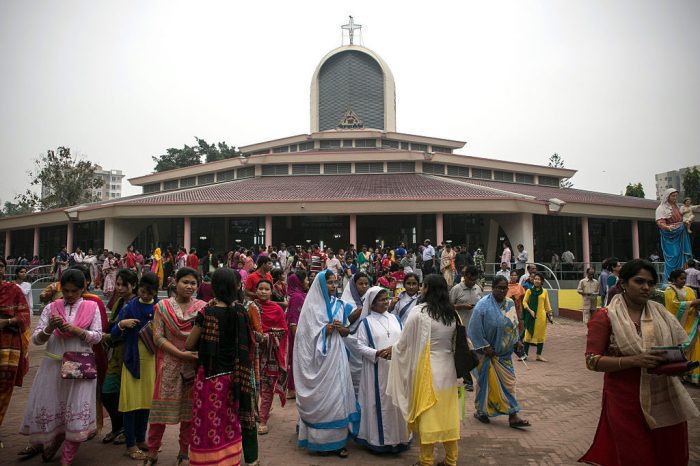
Commentators stress that even in the absence of mass casualties, such attacks serve a purpose: creating fear, disrupting normal religious life, and eroding minority confidence. “A bomb at a church is not only about the explosion,” said a civil-society researcher in Dhaka. “It’s about the signal it sends to the community — you could be next.”
Institutional Responses and Safety Gaps
Fr. Rebeiro and the CBCB have issued public appeals asking the government to ensure Christians can “participate safely in religious activities.” Community security has been increased around Catholic sites, especially after the twin blasts in Dhaka. Yet, faith-leaders argue that preventive measures are still far too limited.
Legal experts suggest that Bangladesh’s laws related to religious freedom, communal violence and hate speech are under-enforced when minority institutions are at risk. Furthermore, in the digital age, threats often begin online (via incendiary posts or targeted hashtag campaigns) before manifesting in physical attacks.
Why the Community Is on Edge
One Gazipur Christian elder described life since the attacks: “We are scared to speak out. The lies spread faster than the truth, and the hatred grows louder every day.” For a community that makes up less than 2% of the national population, even isolated episodes of violence carry existential weight.
Analysts say the timing of the twin attacks — shortly after a high-profile mosque preaching cycle and ahead of major national elections — suggests a climate in which political and religious tensions overlap. Whether the motive is extremist, political, sectarian or some combination thereof remains under investigation.
Looking Ahead
The recent incidents mark a troubling moment for Bangladesh’s commitment to its syncretic, diverse identity. As one inter-faith leader put it, “This is a moment that will test Bangladesh’s moral foundation as a secular democracy.”
For the Christian minority, the options are stark: either the state ensures protection and accountability, or the sense of belonging and safety they rely on continues to erode. Until tangible measures are taken — prosecutions of perpetrators, stronger community-police liaison, and digital-monitoring of hate campaigns — the fear will persist.
In the meantime, Catholic communities across Dhaka and beyond will resume Sunday services, gather for prayer, and hope their homes of worship remain unscathed. But behind their hymns and candles lies the unspoken question: Who will defend them next?


