
Terrorism in Bangladesh is on the rise, exacerbated by the direct support of the interim
government led by Dr. Yunus. This growing threat has contributed to an increasingly unstable security situation in the country.
The involvement of governmental actors in facilitating or endorsing such activities further complicates efforts to restore peace and security. Dr. Yunus leadership of the interim government appears to be systematically undermining the efforts of the Counter Terrorism (CT) unit in the period leading up to 5 th August 2024.
Specifically, senior government officials have been involved in facilitating meetings with extremists, orchestrating the release of militants from detention, deliberately initiating legal actions against CT former officers, and encouraging the families of militants to pursue legal complaints against former CT officials.These actions suggest a concerted effort to hinder CT’s operations and weaken its effectiveness.
Reference: Click Now
Further, Yunus led the government’s perceived tolerance or indirect support for certain extremist elements has further exacerbated the situation. Allegations of political patronage towards groups with extremist leanings, or the failure to take decisive action against known radical organizations like Hizb ut-Tahrir which made a huge procession to make Islamic Khilafah in Bangladesh, have raised concerns about the government’s role in enabling the spread of terrorism. The lack of a comprehensive and proactive counterterrorism strategy has allowed these groups to operate with greater freedom, further contributing to the escalation of violence.
Reference : Click Now
Thousands of inmates, including individuals sentenced to death and 78 militants, have escaped from prisons in Bangladesh. Among these escapees, many are involved in activities that contribute to the growing threats of terrorism and extremism within the country with government support. Their release exacerbates the already volatile security situation in Bangladesh, complicating efforts to combat radicalization and terrorism.
Therefore, nearly 210 convicted militants got bailed with the direct support from the interim government and its affiliated political parties like Jamat-e-Islami, Hefaja-e-Islami, young political students wing named coordinator’s (now, NCP).
In condition of not to expose his name, an ex- counter terrorism and transnational crime (CTTC) officer (who has been ousted by interim government with pressure of freed militant’s) said that those militants were the core soldiers who killed students and mass people during July movement in Bangladesh.
He added that the student leader and Dr. Yunus had liaison with them regarding this in lieu of making them free from jail and conviction. Which is proved from the open procession of Hizb-Ut-Tahrir in Dhaka to form Khilafa in Bangladesh.
Reference: 1. Click Now
Reference: 2. Click Now
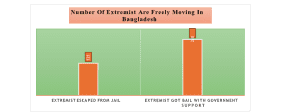
Chart 1: Number Of Extremist Are Freely Moving in BangladeshAccording to various sources, it has been reported that 121 extremists escaped from prison, and after August 5th, 210 extremists were granted bail. These individuals now pose a significant threat as they are in the process of reorganizing their militant networks and conducting training programs in remote and hilly areas, with the intention of executing high-profile militant attacks in Bangladesh.
Reference 3: Click Now
Consequently, CT related officers in Bangladesh have reportedly been intentionally transferred, punished, prosecuted, and, in some cases, imprisoned. These actions appear to be part of a broader strategy to undermine the effectiveness of the counterterrorism forces, potentially compromising national security efforts. Such measures may be indicative of militant interference or a deliberate attempt to threshold the capacity of these officers to effectively combat terrorism and extremism.
The vindictive actions against CT officers not only erode the morale and efficiency of the law enforcement agencies but also raise concerns about the radicalization of security forces. These developments complicate efforts to strengthen the rule of law and create an environment where terrorism and extremism can proliferate with less resistance from the state.
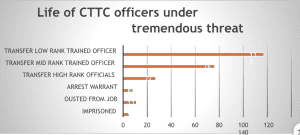
According to multiple sources, the above chart clearly illustrates that a substantial number of counterterrorism (CT) officers in Bangladesh have been subjected to Jihadi prescribed revengeful measures, including the imprisonment of five officers, the dismissal of eleven, and the issuance of arrest warrants for eight others. Furthermore, 27 high-ranking officers, 76 mid-level trained officers, and 117 lower-ranking officers have been reassigned. These developments raise significant concern regarding the integrity and operational efficacy of the CT unit.
Moreover, there are indications that the officers being appointed to replace these displaced personnel are often part of a radicalized faction within the police force. These replacements, allegedly appointed under the authority of the interim government led by Dr. Yunus, have been accused of contributing to a shift in the operational dynamics of CT Unit. As a result, there are claims that the current CT unit is, in effect, facilitating the activities of militant groups, undermining the objectives of counterterrorism efforts. This situation raises important questions about the radicalization of security forces and the implications for national security. As the radicalization of key law enforcement officers could exacerbate the challenges of combating terrorism and extremism in Bangladesh.
Reference: Click Now
Consequently, all counterterrorism (CT) operations conducted prior to August 5, 2024, including “Operation Eagle Hunt” (a two-day counterterrorism operation in the Shibganj upazila of Chapainawabganj, Bangladesh, which led to the deaths of four militants reportedly affiliated with the New JMB, a faction of Jama’atul Mujahideen Bangladesh), and “Operation Holy Artisan” (a response by Bangladeshi security forces to the July 1, 2016 terrorist attack on Holy Artisan Bakery in Dhaka, in which gunmen linked to Jama’atul Mujahideen Bangladesh (JMB) killed 22 individuals, including 17 foreign nationals, and the operation ended with the deaths of the assailants following a raid by CT officers as well as two additional operations resulted in the death of nearly a dozen IS operatives at the hands of Counter Terrorism (CT) officers, along with the criminals apprehended during these operations, have now prompted legal actions against the Counter Terrorism (CT) officers involved, under the purported jurisdiction of the Enforced Disappearance Commission as well as International Crimes Tribunal (ICT).
Reference: Click Now
These operations are being utilized as a tool against the officers, potentially as a means of undermining their authority and effectiveness during the acts with direct support from the “Forcefully disappearance commission”. Furthermore, all major CT operations are now being scrutinized and used to challenge the actions and decisions of the officers involved. This situation raises significant concerns about the radicalization of counterterrorism efforts, as the legal proceedings against these officers may not only convicted them for performing their duties but also serve to delegitimize the broader efforts to combat terrorism and extremism in Bangladesh.
The use of retributive legal mechanisms in this context suggests an effort to disrupt and discredit counterterrorism operations, which may have serious implications for national and international security.
Interestingly, the commission is chaired by the retired Justice Moinul Hossain Chowdhury of the High Court Division, who is the maternal uncle and father-in-law of the notorious militant Syed Mohammad Ziaul Haque, also known as Zia.
Haque has been convicted for his involvement in several high-profile militant attacks in Bangladesh and is currently fugitive. Similarly, another member of the commission, Nabila Idris, a faculty member at BRAC University, has known associations with Hizbut-Tahrir, an extremist group. Therefore, it would be challenging for the ‘Forcefully disappearance commission’ to deliver an objective and impartial recommendation,considering the familial ties of the commission chief to a high-profile and notorious militant such as Zia.
This refers to the strategic use of state apparatus, including the Enforced Disappearance Commission and the International Crimes Tribunal (ICT), in a retributive manner against Counter Terrorism (CT) officials. This suggests that the interim government is, in effect, facilitating and endorsing the activities of Islamist militants in Bangladesh.


