
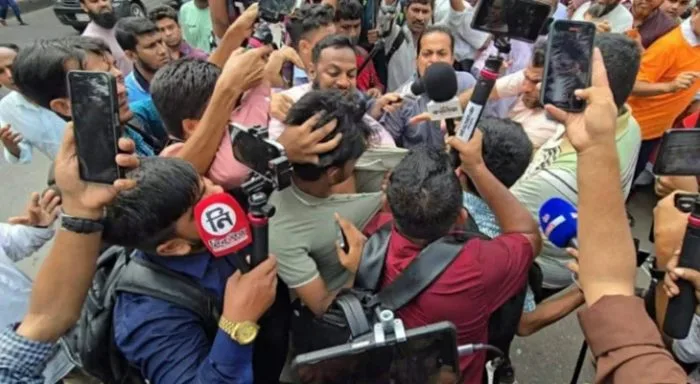
At least three journalists were injured, one seriously, after Jamaat-e-Islami activists attacked reporters covering a protest march in Dhaka’s Dhanmondi 32 area on Tuesday, intensifying concerns over press freedom and journalist safety. The march was organized against the perceived resurgence of the Awami League ahead of the party’s 77th founding anniversary.
The incident occurred as authorities enforced one of the largest security operations seen in the capital in recent years. More than 18,000 members of the Dhaka Metropolitan Police (DMP) were deployed across the city, while personnel from the Bangladesh Army and Border Guard Bangladesh (BGB) were stationed in key locations to prevent potential unrest linked to the anniversary of the Awami League, whose political activities remain prohibited by the authorities.
Journalist Assault Sparks Outrage
According to eyewitnesses and media reports, tensions erupted shortly after a protest procession organized by Jamaat-e-Islami in the Dhanmondi 32 area, historically associated with Bangladesh’s founding leader Bangabandhu Sheikh Mujibur Rahman.
Journalists covering the event said some participants began arguing with them shortly after the procession, and the confrontation later escalated into physical violence.
Among those injured was Mahfuzur Rahman Shishir, a multimedia reporter with Daily Sakal. Witnesses said he was surrounded and beaten, suffering injuries to his face and mouth before fellow journalists rescued him and arranged medical treatment.
Reports also indicated that Kalbela reporter Abdur Rahman Ishan and Jamuna TV reporter Rabbi Siddique sustained injuries during the confrontation. Other journalists present at the scene alleged that they were harassed and intimidated while carrying out their professional duties.
Witness accounts suggest that several media workers were subjected to intimidation or physical abuse during the incident.
Eyewitnesses said the protest march began at around 8:30 a.m. in the Dhanmondi 32 area. Jamaat leaders Mustafizur Rahman, Mujahidul Islam Shahin, Anisuzzaman and Jahinur Rahman, along with local party activists, reportedly participated in the program.
Jamaat Expresses Regret
Following widespread criticism, leaders of Jamaat-e-Islami described the incident as unfortunate.
According to reports published after the attack, Dhanmondi Thana Jamaat Working Committee member Mujibur Rahman Khan said the assault was “unfortunate” and expressed regret over what had happened to journalists covering the rally. He made the remarks while responding to journalists following the controversy surrounding the Dhanmondi incident.
Journalist organizations and press freedom advocates subsequently condemned the attack and demanded the swift identification and prosecution of those responsible.
Several media bodies also expressed concern over the safety of journalists covering politically sensitive events and called on the authorities to ensure protection for reporters performing their professional duties.
Security Operation Across Dhaka
The violence unfolded against the backdrop of extraordinary security measures implemented throughout Dhaka ahead of the Awami League anniversary.
DMP had announced in advance that more than 18,000 police personnel would be deployed throughout the capital, accompanied by over 200 special checkpoints, pickets and surveillance points. Authorities said the measures were designed to prevent sabotage, violence and potential confrontations among rival political groups.
At a press briefing at the DMP Media Centre on Minto Road on June 19, DMP Additional Commissioner (Crime and Operations) S.N. Md. Nazrul Islam said police remained on alert despite having no specific intelligence indicating a direct threat.
“There are no security concerns surrounding the upcoming June 23 founding anniversary of the Awami League. However, the DMP remains on alert ahead of the day,” he told reporters.
In the days leading up to the anniversary, authorities intensified raids and surveillance operations. Law enforcement agencies arrested dozens of Awami League leaders and activists in various parts of the country, alleging involvement in activities linked to the party and plans to create public disorder.
Earlier on Monday, police said 26 Awami League and affiliated organization leaders and activists had been arrested in separate operations in Dhaka. Authorities alleged that the detainees were attempting to organize political programs and activities in violation of existing restrictions.
Army and BGB Deployed
The government also ordered military deployment in Dhaka and several other districts to support civilian law enforcement agencies.
Home Minister Salahuddin Ahmed said the deployment followed intelligence reports indicating possible attempts to organize demonstrations and create instability surrounding the anniversary.
“They are attempting to incite unrest through processions and rallies in different districts. Law enforcement agencies have been instructed to remain on high alert to prevent any disorder,” the minister told reporters while explaining the deployment.
According to official announcements, army personnel were assigned to Dhaka, Chattogram, Gazipur, Narayanganj, Faridpur and Gopalganj until June 30 to assist the civil administration and help maintain law and order.
BGB personnel were also deployed at strategic locations, while additional security measures were implemented at entry points to the capital, government installations and politically sensitive areas.
Growing Concerns Over Press Freedom
The assault has renewed concerns about the increasingly difficult environment facing journalists covering political events in Bangladesh.
Press freedom advocates argue that reporters covering demonstrations, rallies and political gatherings continue to face risks from political activists, hostile crowds and, at times, security personnel.
Tuesday’s incident has once again highlighted the vulnerability of journalists working on the front lines of political unrest and the challenges of ensuring safe access to newsworthy events.
Media organizations have urged authorities to conduct a thorough investigation and ensure accountability, emphasizing that attacks on journalists not only threaten individual reporters but also undermine the public’s right to information.
Political Tensions Remain High
Founded on June 23, 1949, the Awami League remains one of Bangladesh’s most influential political organizations despite the restrictions imposed on its activities. The anniversary has become a focal point for political tensions, with authorities fearing possible demonstrations and rival groups organizing counter-programs.
While officials insist the situation in the capital remains under control, Tuesday’s violence in Dhanmondi has underscored the fragile political atmosphere.
With police, army and BGB personnel continuing patrols across Dhaka and intelligence agencies maintaining heightened surveillance, concerns persist over whether further confrontations could occur in the coming days as Bangladesh’s political tensions continue to simmer.


COMMENTS