
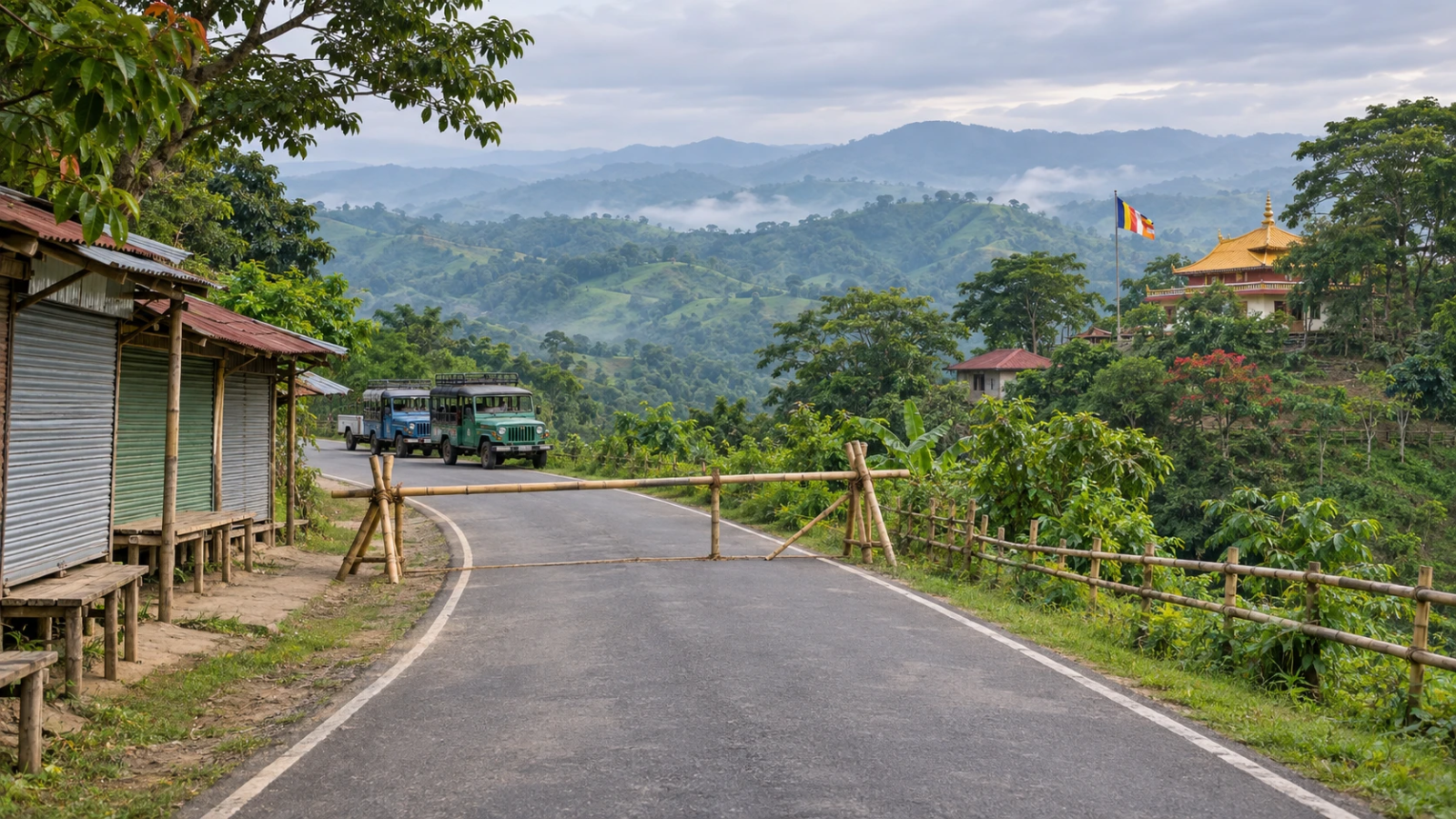
A prolonged blockade in Sajek, a popular hill destination in Rangamati district, has forced the cancellation of the Buddhist community’s annual Kathina Robe Offering ceremony, adding to mounting concerns over the humanitarian and economic impact of the ongoing unrest.
The disruption has brought transport and normal economic activities in the area to a near standstill, leaving residents struggling to access essential supplies, including food and medicine. Farmers and traders have also suffered as agricultural produce cannot be transported to markets, raising fears of mounting financial losses.
The latest wave of disruption began on October 11, when the Sajek Committee for the Protection of Public Rights and the Sajek Karbari Association called a blockade to press five demands. A counter-blockade was subsequently organised by another group, the Committee for the Protection of the Chittagong Hill Tracts, in protest against alleged acts of violence.
The competing programmes have effectively paralysed road communications in the area for weeks.
With transport services disrupted, farmers have been unable to bring their produce to market on time, while residents face growing difficulties travelling outside Sajek for essential services. The interruption of supply chains has further intensified concerns over access to basic necessities.
The crisis has also disrupted religious life in the predominantly indigenous hill community. Organisers have cancelled the Kathina Robe Offering ceremony at Banani Bon Bihar in the Baghaihat area, citing the prevailing situation and security concerns.
The decision was announced in a notice signed by the festival’s organising committee.
The Kathina ceremony is one of the most significant annual observances in Theravada Buddhism. According to religious tradition, devotees prepare a robe for Buddhist monks within 24 hours, beginning with cotton that is spun into thread, woven into fabric and made into a robe for offering. The ceremony is regarded as an exceptionally meritorious act of giving.
Doyadhan Chakma, a member of Sajek Union Parishad, described the cancellation as deeply regrettable, saying the blockade had prevented members of the Buddhist community from observing an important religious occasion.
He warned that such disruption could undermine religious sentiments and social harmony.
Rahmatullah Khaja, general secretary of the Baghaichhari municipal unit of the Bangladesh Nationalist Party (BNP), said the prolonged blockade had pushed residents into an increasingly difficult situation, with access to basic necessities and medical care becoming a major challenge.
He urged the authorities concerned to take effective measures to restore normalcy.
Despite several rounds of talks between the administration and the protesters, the standoff remains unresolved.
Local residents have called on the parties involved to resolve their differences through dialogue and restore road connectivity, warning that continued disruption could deepen the food and healthcare crisis and cause further damage to agriculture, commerce and tourism.
The cancellation of the religious festival has added another dimension to the crisis, highlighting the wider impact of the prolonged standoff on residents’ livelihoods, religious practices and social life.


COMMENTS