
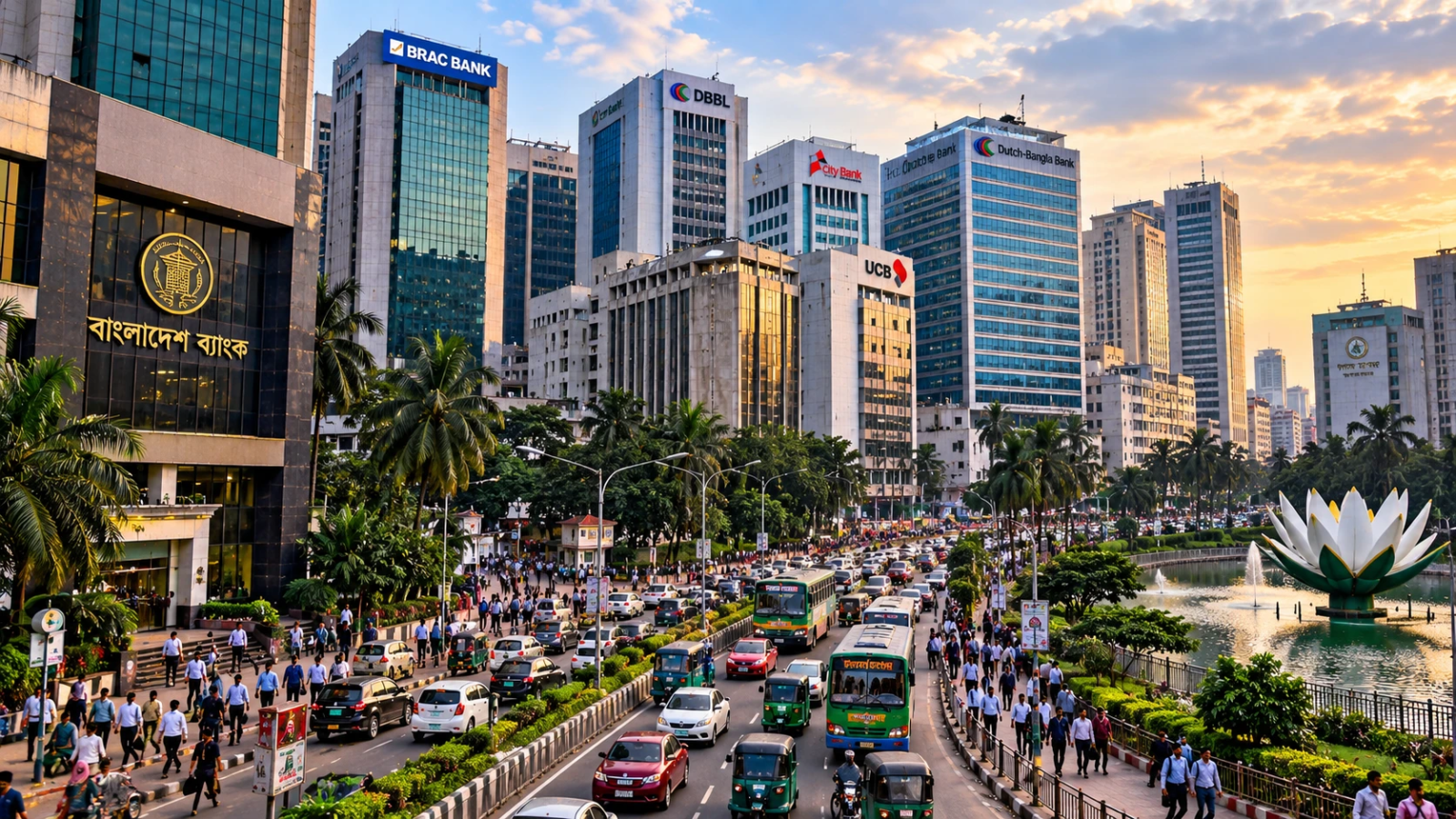
Bangladesh’s economic growth has slowed sharply, while weak private investment, subdued job creation, energy shortages and mounting banking-sector vulnerabilities are putting further pressure on the economy, according to the World Bank’s October 2026 Bangladesh Development Update.
The report, titled “Make Subsidies and Social Protection Work Better for the Poor,” says high inflation continues to erode real incomes and purchasing power, while poverty and income inequality are rising.
The World Bank has urged Bangladesh to restore stability in the banking sector, strengthen energy security, improve governance and raise tax revenues. It also recommended gradually reducing broad-based subsidies and redirecting support towards poor and vulnerable households.
According to the World Bank, Bangladesh’s real GDP growth slowed to 3.4% in fiscal 2025-26, down from 5.8% in FY2022-23. Growth had already fallen to 4.2% and 3.5% in the following two fiscal years.
In the third quarter of FY2025-26, growth dropped further to 2.2%, the lowest quarterly growth since the COVID-19 pandemic.
The slowdown was driven in part by declining investment. Private investment fell 0.5% and public investment declined 0.7% during the fiscal year, while real exports of goods and services fell 4.8%.
The implementation of the Annual Development Programme also dropped to historically low levels amid reviews of major infrastructure projects, caution over approving new projects and weak implementation capacity.
Industrial growth was around 2% in FY2025-26. However, industrial output contracted by 0.3% in the third quarter, marking the first quarterly contraction in the sector since the pandemic.
The World Bank said shortages of gas and electricity forced many factories to operate below capacity.
Some businesses reduced working hours, suspended production or laid off workers.
Bangladesh, which was nearly self-sufficient in gas until 2017, now meets around one-third of its gas demand through imports. The country’s heavy reliance on several major gas fields and floating LNG terminals in Maheshkhali also creates supply risks if any major facility faces disruption.
Women’s participation in labour force declines
The economic slowdown has also affected the labour market, particularly women working in the industrial and services sectors.
The female labour-force participation rate declined from 42.8% in 2022 to 38.4% in 2024. The World Bank said it was difficult to assess the latest situation accurately because no new labour-force survey has been conducted since 2025.
Average inflation declined from 10% in FY2024-25 to 8.7% in FY2025-26, while point-to-point inflation stood at 8.3% in August.
Despite the decline, the World Bank said inflation remains elevated because of higher electricity and energy prices, supply-side constraints and growth in money supply.
Average retail electricity prices increased by around 16.7%, while wages of low-income workers failed to keep pace with inflation. Their real wages turned negative again in August.
The World Bank estimates that Bangladesh’s poverty rate under the international poverty line of $3 a day increased by 1.1 percentage points to 10.1% in FY2025-26.
This means around 2.1 million additional people fell below the international poverty line within a year.
Under the national poverty line, the situation is also deteriorating. The national poverty rate rose from 18.7% in 2022 to an estimated 22.5% in FY2025-26, marking the fourth consecutive year of increase. Income inequality also widened.
Banking sector emerges as a major risk
The World Bank identified weaknesses in the banking sector as one of the most serious risks facing Bangladesh’s economy.
The non-performing loan ratio rose from 20.2% in December 2024 to 33.2% in June 2026. The ratio was even higher among Islamic banks, at 58.9%, and state-owned commercial banks, at 43.2%.
The banking sector’s overall capital adequacy ratio fell to negative 2.6% in December 2025, compared with the regulatory minimum of 10%.
The report said relaxed provisioning requirements meant banks did not have to maintain provisions equivalent to around $17 billion through March 2026, potentially masking the sector’s underlying weaknesses.
Unsecured liquidity support from Bangladesh Bank to weak banks reached Tk 760 billion in June 2026.
The World Bank welcomed the passage of the Bank Resolution Act and Deposit Protection Act but warned that repeated regulatory forbearance and liquidity support could delay the recognition and resolution of actual losses.
Bangladesh Bank cut its policy rate by 0.5 percentage point to 9.5% on July 30, marking the first policy-rate cut in six years.
Despite the move, credit growth to individuals and private businesses fell to just 4.5% in June, the lowest level in 33 years. Government-sector credit, meanwhile, grew by 30.4%.
The World Bank warned that limits on the interest-rate spread could make borrowing more difficult for smaller and riskier businesses. Banks could become more inclined to lend to large companies or the government rather than small and medium-sized enterprises.
Remittances rose 17.3% to a record $35.6 billion in FY2025-26. However, the current-account deficit widened to around $1.6 billion.
Merchandise exports declined by 0.2%, while imports increased 10.5% to $71.1 billion. Import costs for petroleum products rose by 107%.
Bangladesh also faced increased pressure in the US apparel market. During the first six months of 2026, US apparel imports overall declined 7.1%, while imports from Bangladesh fell 5.3%. Imports from Vietnam, Indonesia and Cambodia increased during the same period.
Net foreign direct investment fell 15% to around $1.5 billion, equivalent to only 0.3% of GDP. New equity investment plunged 70.3%.
Government increasingly dependent on bank financing
Bangladesh’s budget deficit increased from 3.4% of GDP to 3.9% in FY2025-26.
During the first 11 months of the fiscal year, 81.5% of the government’s total financing came from the banking sector, compared with 34.8% in the previous fiscal year.
The World Bank warned that increased government borrowing from banks could crowd out private-sector credit, keep lending rates elevated and constrain investment and employment.
Public debt increased from 38.9% to 40.5% of GDP, while interest payments reached around 2.6% of GDP.
The National Board of Revenue collected 82.6% of its tax target in FY2025-26. Total revenue increased from 8% to 8.3% of GDP, with tax revenue accounting for around 7%.
A narrow tax base, tax evasion, weak administration and excessive tax exemptions continue to constrain revenue mobilisation.
Meanwhile, total government expenditure increased from 11.4% to 12.2% of GDP. Current expenditure rose from 8.7% to 9.7%, while capital expenditure declined from 2.8% to 2.5%.
The World Bank estimates that full implementation of a new public-sector pay structure could raise average basic salaries and allowances by around 120% and pensions by around 70%, adding approximately 0.6% of GDP to government spending in FY2026-27.
Growth expected to remain weak for two years
The World Bank projects Bangladesh’s economic growth to remain at 3.4% in FY2026-27, well below the 10-year average of 5.6%.
Growth could rise modestly to 3.9% in FY2027-28.
Around 630,000 net jobs could be created in the next fiscal year, but the World Bank said this would not be enough to reduce poverty rapidly.
The national poverty rate is projected to rise to 22.8% in FY2026-27 before edging down to 22.4% the following year. Average inflation is projected at 8.6% and 7.1%, respectively.
World Bank calls for structural reforms
The World Bank has called for urgent reforms in three key areas—banking, energy and revenue.
In the banking sector, it recommended completing asset-quality reviews, determining which banks are viable and ensuring that owners, investors and other stakeholders bear an appropriate share of losses. Regulatory forbearance should also be gradually withdrawn.
In the energy sector, the report called for greater domestic gas production, expanded LNG infrastructure, stronger electricity transmission and distribution networks and increased investment in renewable energy. It also recommended transparent and competitive tendering for power projects and electricity procurement.
On revenue mobilisation, the World Bank recommended separating tax policy from tax administration, using government data more effectively to identify tax evasion and gradually reducing ineffective tax exemptions.
The report concludes that restoring sustainable economic growth will require more than temporary support. Bangladesh needs to address the underlying weaknesses in its banking system, improve the investment climate, strengthen energy security and undertake structural reforms in revenue management.



COMMENTS