
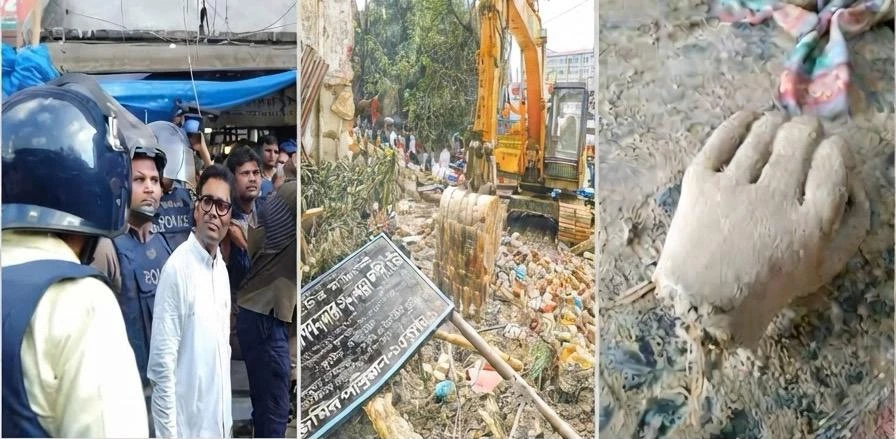
Bangladesh is facing growing concerns over deaths in custody, attacks on civilian institutions and violence targeting political spaces. In September 2026, the human rights organisation Manabadhikar Shongskriti Foundation reported 24 deaths in jail custody, while the Human Rights Support Society documented at least two deaths in law enforcement custody along with allegations of torture.
The concerns extend beyond custodial deaths. On September 24, the Radda MCH FP Centre, a prominent mother and child healthcare facility in Dhaka, was reportedly attacked, vandalised and looted before being demolished with heavy machinery. Two days later, an incident took place at the central office of the Jatiya Samajtantrik Dal in Gulistan during a scheduled central representative meeting.
These incidents are not isolated concerns about individual victims or damaged property. They touch on a much wider question about public safety, accountability, freedom of expression and the strength of democratic institutions. When people fear that they may lose their lives or face abuse in state custody, trust in law enforcement and the justice system begins to weaken. When public institutions, healthcare facilities or political offices can be attacked without effective accountability, the sense of security needed for a healthy democratic society is also put at risk.
The Question of Custody and State Responsibility:
The sharp rise in deaths in custody is perhaps the most disturbing finding. MSF recorded 24 deaths among prisoners and detainees in September, compared with nine in August, and all those who died were men. When the state takes a person into custody, it assumes responsibility for that person’s safety and well being. A prisoner cannot choose his doctor, leave the facility when he wants or independently protect himself from abuse or neglect. Every custodial death therefore raises serious questions about what was done to protect that person’s life. Were illnesses left untreated? Was medical care provided in time? Were there allegations of torture or physical abuse? Were independent post mortems conducted? Were prison authorities properly investigated? Was anyone held responsible where negligence or misconduct was established? The increase from nine to 24 deaths in a single month should not simply be treated as a statistical fluctuation. Behind every number is a human life and a family left with unanswered questions. Credible investigations, transparency and public explanations are essential to prevent suspicion from taking the place of truth. The same principle must apply to allegations of extrajudicial killings. A state cannot expect its citizens to respect the rule of law unless state institutions themselves are held to the same standard.
Mob Violence and the Collapse of Due Process:
MSF recorded at least 23 incidents of mob violence in September, leaving 23 people dead and 74 injured. Mob violence is sometimes described as spontaneous public anger, but when a crowd treats an accusation as proof of guilt and imposes punishment without a court, the basic principles of justice are put at risk. Every person accused of a crime has the right to be heard and tried according to law. No crowd has the authority to become judge, jury and executioner. The danger becomes even greater when those responsible for such violence are not effectively investigated and prosecuted, because it can create the perception that violence carries little consequence. The state must therefore do more than disperse crowds after violence begins. It must investigate attacks, bring perpetrators to justice and make clear that no political, religious or social influence places anyone above the law. Extremism does not always emerge through organised groups. It can also grow through rumours, online incitement, collective hatred and the gradual acceptance of violence against alleged offenders or unpopular groups. When accusation replaces evidence and punishment replaces due process, the rule of law begins to lose its meaning.
Political violence remained a serious concern in September. According to MSF, 384 people were injured and at least one person was killed in incidents of political violence during the month, while seven others were reportedly killed in attacks by unidentified assailants. Political competition is a normal part of democracy, but violence is not. The state has a responsibility to protect every citizen, regardless of political affiliation, and justice should never depend on which party a victim supports or which political group an alleged perpetrator belongs to. When laws are enforced selectively, it can create a sense of impunity and weaken public confidence in the justice system. If people believe that supporters of one political group receive protection while members of another are targeted, the principle of equal justice is placed in question. A democratic state must apply the law consistently and impartially, even when doing so is politically difficult or inconvenient.
Mob Attack and Mass Detention Involving Ruling-Party Activists:
On September 26, 2026, a political meeting at the central office of the Jatiya Samajtantrik Dal (Jasod) in Gulistan, Dhaka, became the scene of a serious confrontation. According to Jasod officials and media reports, Jubo Dal activists surrounded and attacked the office while hundreds of delegates, including women, were inside, disrupting the meeting and leaving participants trapped amid the violence. The confrontation was followed by a police raid in which between 280 and 400 people were detained. Although 249 were later released after identity checks, 27 were arrested and reportedly denied bail. Whatever the allegations surrounding the gathering, the incident raises grave concerns about freedom of peaceful assembly, political expression and participation. A democracy cannot function when political meetings are disrupted by mobs, participants are subjected to mass detention, or people face arrest for expressing political views. Such incidents risk turning political disagreement into intimidation and making the exercise of basic democratic rights increasingly dangerous.
The September figures also raise concerns about press freedom and digital expression in Bangladesh. MSF recorded 28 journalists facing attacks or other forms of abuse, while nine journalists reportedly faced legal harassment. Cases brought under digital or cyber related laws increased from three in August to eight in September, with arrests also rising from three to eight. Laws addressing cybercrime have a legitimate role in protecting people and society, but their enforcement must not become a means of silencing journalism, criticism or peaceful dissent. People do not have to be physically attacked to be silenced. The fear of arrest, prosecution or a legal case can be enough to make journalists, activists and ordinary citizens think twice before expressing their views. Freedom of expression requires protection not only from physical violence, but also from the misuse of legal power. A society cannot remain genuinely democratic when people are afraid to speak.
Seventy-one Unidentified Bodies:
Another deeply troubling figure is the recovery of 71 unidentified bodies across Bangladesh during September. According to MSF, 55 were men and 15 were women, while the age and sex of one person could not be determined. Behind every unidentified body is a person who had a family, relationships and a life. Somewhere, in many cases, there may be a family waiting for someone who never returned home. The authorities need an effective national system for identifying unidentified bodies, recording missing persons and informing families. Every unidentified death should be properly investigated. Families should not have to depend on chance, social media or rumors to discover what happened to a missing relative.
MSF also documented at least 10 incidents of idol vandalism and one incident of ethnic persecution during September. These incidents deserve serious attention. Religious and ethnic minorities are entitled to equal protection under the law. Attacks on places of worship, religious symbols or ethnic communities are not simply isolated property offences. They raise a larger question about whether minorities can live as equal citizens without fear. The government’s response matters. Authorities must investigate such incidents promptly, prosecute those responsible and ensure that political or religious influence does not interfere with the process.
Equal citizenship has meaning only when the law protects minorities as effectively as it protects the majority.
What Democracy and Good Governance Demand:
The September figures do not allow for a simple conclusion that Bangladesh’s human rights situation is either improving or deteriorating. The reality is more complicated. Some indicators showed improvement, with mob violence reportedly declining and physical attacks on journalists decreasing. At the same time, other concerns became more serious. Deaths in custody increased, political violence left hundreds injured, cyber law cases and arrests reportedly rose, and 71 unidentified bodies were recovered. Religious and ethnic minorities also continued to face attacks. These developments show that progress in one area cannot be taken as evidence of broader institutional improvement. Good governance is not measured by the absence of bad news. It is measured by how effectively, transparently and fairly institutions respond when serious problems occur. A democratic state is ultimately judged by whether it protects life, respects rights, investigates abuses and holds those responsible accountable, regardless of their political identity or influence.
Democracy is not only about elections or changes in government. Its real strength is revealed in the everyday protection of rights and dignity. An ordinary accused person should be able to expect a fair trial, a prisoner should be able to remain safe in custody, a journalist should be able to investigate and criticise without intimidation, and a minority family should be able to expect equal protection from the state. The rule of law means that no mob, political party or state institution should stand above the law. Monthly human rights statistics will continue to arrive, but the more important question is what happens after those numbers are published. Are allegations properly investigated? Are victims heard? Are those responsible held accountable? A country is truly secure only when the law protects people everywhere, including inside a prison cell, in a hospital, in a political office and in the public square. That is the real test of democracy and the rule of law.
PARVEZ HASHEM, Lawyer and Human Rights Defender






COMMENTS