
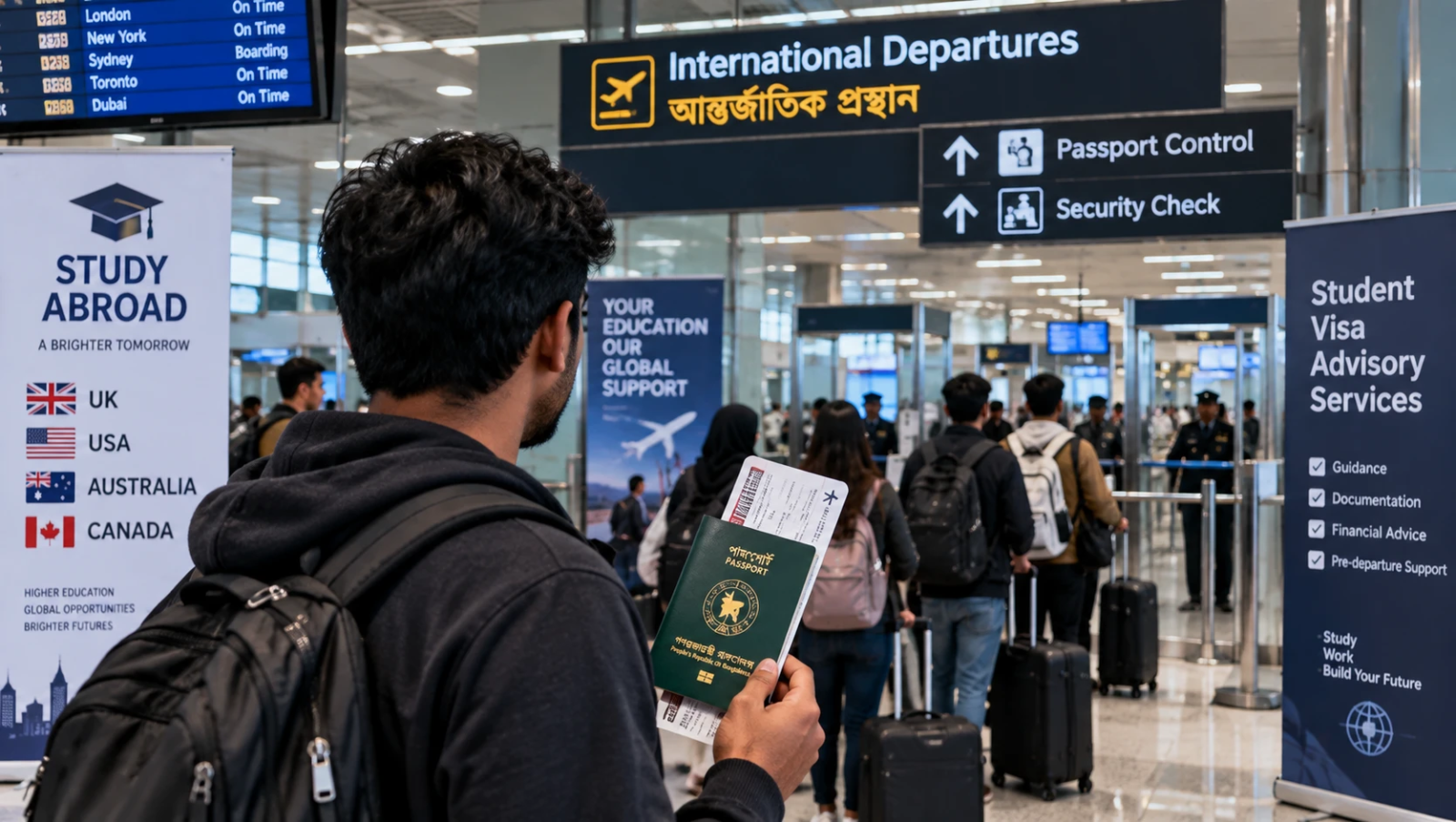
The path to higher education abroad is becoming increasingly challenging for Bangladeshi students as major study destinations tighten admission and visa rules.
In the United Kingdom, several universities have suspended applications from Bangladeshi students, while others have introduced restrictions based on applicants’ location, academic level or chosen course.
Australia is tightening rules aimed at preventing so-called “visa hopping” and limiting opportunities for international students to bring family members. In the United States, social media activity is being scrutinized as part of the visa process for applicants seeking F, M and J visas.
As a result, gaining admission to a foreign university no longer guarantees that a student will receive a visa. University selection, the relevance of the chosen course, financial documentation, academic history, compliance with visa conditions and plans after graduation are all receiving greater scrutiny.
UK universities restrict applications
The most visible restrictions for Bangladeshi students are emerging in the UK admissions process.
Several universities have reportedly suspended applications from Bangladesh altogether, while others have imposed restrictions on applicants from particular regions, degree levels or courses. Some institutions have also restricted the issuance of a Confirmation of Acceptance for Studies (CAS) to certain applicants.
A number of universities have introduced specific restrictions affecting students from Sylhet. These reportedly include the University of South Wales, Aberystwyth University, the University of Chester, Canterbury Christ Church University, Regent College London and the University of Brighton.
Some institutions have also restricted undergraduate applications from students in Dhaka and Sylhet. Other universities have focused their restrictions on particular programmes. Birmingham City University and Buckinghamshire New University have suspended applications for certain undergraduate and master’s programmes, while the University of Derby and the University of Greater Manchester have reportedly introduced restrictions affecting master’s and PhD-level admissions.
Visa-compliance risks are a key factor behind the restrictions in the UK.
Under the revised Basic Compliance Assessment framework, universities face a greater risk to their sponsor licences if their student visa refusal rate reaches 5% or more. The threshold was previously 10%.
The visa refusal rate among Bangladeshi applicants is reported to be around 22%, according to the information cited by সংশ্লিষ্টরা in the report. Universities are therefore seeking to reduce compliance risks associated with their international student recruitment.
Concerns reportedly include inconsistencies in financial documents, failures during visa or credibility interviews and applications for asylum after students arrive in the UK.
Australia tightens visa switching rules
In Australia, the stricter measures are part of broader efforts to control migration.
The country has set a target of reducing net overseas migration to 245,000 in the 2026–27 financial year and 225,000 in the following financial year.
Authorities are also tightening restrictions on “visa hopping”—the practice of repeatedly changing visas or enrolling in lower-level courses to extend a stay in Australia after completing higher education.
At the same time, opportunities for most international students to bring family members to Australia have been restricted, although exceptions remain for some categories, including certain PhD students.
US expands scrutiny of applicants’ online activity
The United States is taking a different approach to increased scrutiny.
Applicants for F, M and J visas are subject to reviews of their social media activity. This means that, alongside university admission, academic qualifications and proof of funds, applicants’ online presence can also become relevant during the visa process.
The US has also considered changes to rules governing how long international students can remain in the country.
European countries also increasing scrutiny
Bangladeshi students are also reportedly facing various challenges related to maintaining legal residence in Germany and other European countries.
Dr. Md. Ashikur Rahman, Asia Regional Manager of the Erasmus Plus National Focal Points programme under the European Commission and former president of the Erasmus Mundus Association, said the recent measures in the UK and Australia should not be viewed solely as actions targeting Bangladeshi students.
According to him, the tighter rules are part of broader policies aimed at controlling irregular migration, preventing misuse of student visas, identifying fraudulent or low-quality applications and managing the number of international students.
He said opportunities to remain abroad after completing education have not disappeared entirely, but they are becoming more limited and competitive. Simply going abroad to study can no longer be viewed as a guaranteed pathway to permanent residence, he added.
Dr. Rahman said international education and lawful migration pathways remain available to Bangladeshi students, but weak preparation and plans focused primarily on migration are becoming increasingly risky. He advised students to make education decisions based on reliable information, skills development and long-term career planning.
Meanwhile, foreign missions have repeatedly warned Bangladesh and Bangladeshi applicants about submitting fraudulent documents. Bangladesh’s Ministry of Foreign Affairs has also said the government is working in coordination with relevant authorities to prevent the use of forged documents.
For Bangladeshi students, the changing rules mean that securing admission is only one part of the process. Strong academic preparation, credible financial evidence, genuine study plans and strict compliance with visa requirements are becoming increasingly important in pursuing higher education abroad.






COMMENTS