
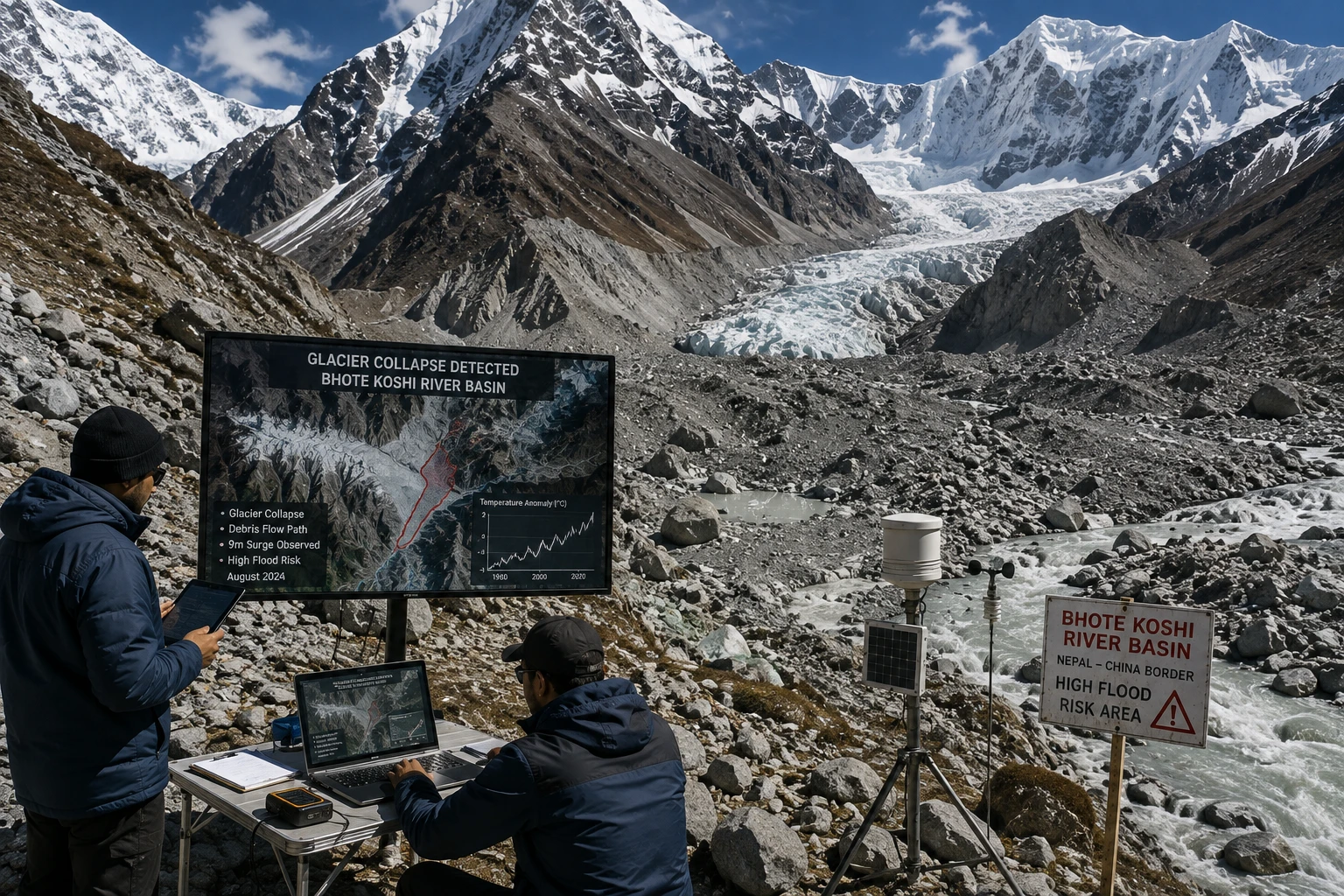
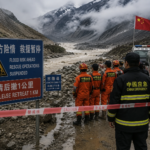
A massive glacier collapse that temporarily blocked a river is emerging as a key factor behind the devastating flash floods that struck Nepal on Wednesday, according to scientists conducting preliminary assessments.
Researchers analysing satellite imagery, seismic data and ground observations believe a huge mass of ice and rock crashed into a tributary of the Bhote Koshi River, triggering a sudden surge of water and debris downstream. Hundreds of people have reportedly been killed or affected, while foreign tourists and pilgrims remain among those missing.
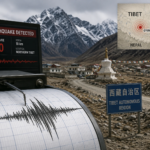
The US Geological Survey (USGS) recorded a magnitude 5.2 event associated with the glacier collapse. Scientists say the resulting debris spread through the lower river basin, causing widespread destruction.
Jakob Steiner, a geoscientist at Austria’s University of Graz, said a massive section beneath the glacier appeared to have broken away. Satellite images, he said, gave the impression that the lower portion of the glacier had been sliced away by a giant knife before crashing down the mountain.
Steiner compared the impact of such a huge mass of ice falling from a great height to a major explosion, saying it could explain the scale of the destruction.
Water level rose by 9 metres in just 30 minutes
According to a Kathmandu-based research team, a mixture of ice and rocks rushing down from upstream caused river levels in the affected areas to rise by nearly 9 metres (29.5 feet) within just 30 minutes.
This was a massive and very sudden rise in water,” said Sashwat Sanyal, a disaster-risk reduction specialist at the International Centre for Integrated Mountain Development (ICIMOD).
Scientists are investigating whether the initial ice-and-rock collapse triggered a chain reaction. The debris may have temporarily blocked the river, creating a natural dam. Water accumulating behind the blockage could then have burst through, dramatically increasing the scale and speed of the flood.
Climate change is increasing the risk
Scientists caution that it would be premature to establish a direct link between Wednesday’s disaster and climate change. However, they say rising global temperatures are fundamentally altering the Hindu Kush Himalaya, increasing the vulnerability of glaciers and mountain slopes.
The Hindu Kush Himalaya contains more ice and snow than anywhere outside the polar regions. More than 63,000 glaciers in the region feed at least 10 major Asian river systems, providing water, food, energy and livelihoods for hundreds of millions of people.
ICIMOD research indicates that glacier ice loss in the region has accelerated sharply, with the rate of melting doubling since 2000. As glaciers retreat, meltwater can enlarge glacial lakes, increasing the risk of glacial lake outburst floods.
At the same time, warming temperatures, changing rainfall patterns and the thawing of permanently frozen ground can weaken mountain slopes and make large-scale rock and ice collapses more likely.
Sanyal said Wednesday’s disaster may have been the result of a cascading sequence: a landslide or glacier collapse followed by a debris flow, temporary river blockage and, ultimately, a devastating flood.
A growing pattern of mountain disasters
The Himalayas have experienced several major disasters in recent years. A glacial lake outburst flood struck the same valley in 2025, while another major ice-and-rock collapse occurred elsewhere in the region in 2024. The 2015 Nepal earthquake also triggered massive avalanches across the wider Langtang region.
Steiner warned that such events could become increasingly difficult to manage as the Himalayan environment changes.
The past decade was the warmest on record, while 2024 was the hottest year recorded at the time. According to United Nations data cited in the report, glaciers lost an average of 267 gigatonnes of ice annually between 2000 and 2019.
Even if global warming is limited to 1.5°C, researchers have warned that around half of the world’s glaciers outside Greenland and Antarctica could disappear by 2100. Under current policies, global temperatures could rise by about 2.8°C above pre-industrial levels by the end of the century.
Warning systems urgently needed
Rapid urbanisation and the expansion of infrastructure into vulnerable mountain valleys are adding another layer of risk.
Steiner noted that around 10 percent of Nepal’s total electricity generation capacity was located in the affected valley. He questioned whether adequate early-warning systems had been installed for local communities and tourists following previous disasters.
Nepal attracts more than one million foreign tourists each year, many of whom travel into high-altitude and remote mountain areas.
Scientists say stronger early-warning systems, better monitoring and faster cross-border sharing of information are urgently needed across the Himalayas. But monitoring thousands of glaciers, steep slopes and river valleys remains extremely difficult.
When a major collapse begins, communities may have only minutes to react.
“We don’t have hours and hours,” Sanyal said. “We have only minutes to prepare.”
Steiner warned that some areas of Nepal may already have crossed a “red line” in terms of safety for human habitation.
“We know what needs to be done,” he said, stressing that governments and other stakeholders must coordinate efforts and turn existing knowledge into practical action.
Source: AP

COMMENTS