
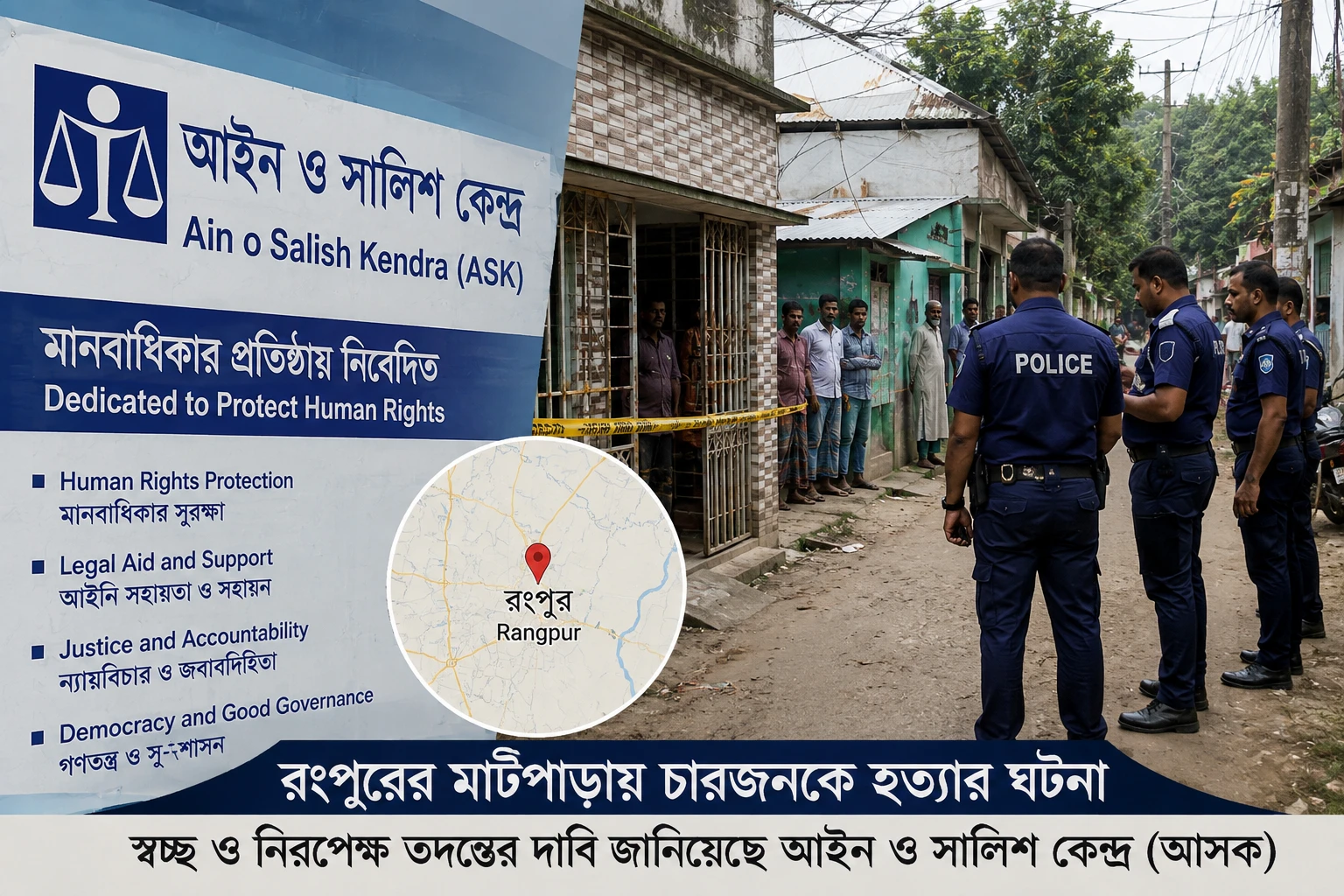
The Ain o Salish Kendra (ASK), a leading Bangladeshi human rights organisation, has called for a full, impartial and professional investigation into the killing of four members of the same family in Rangpur.
The organisation conducted a preliminary fact-finding investigation into the deaths of retired teacher Ganapati Chakraborty, his wife Pritilata Chakraborty, and their two children, Agami Chakraborty and Ayush Chakraborty.
The four were allegedly killed at their home in Machuapara area of Rangpur on the night of August 20. Their deaths came to light on the night of August 22, when relatives went to the house after failing to contact the family. Police and fire service personnel later entered the house and recovered the four bodies.
Following the incident, police arrested two people and gave a preliminary account of the possible motive and sequence of events. However, ASK said its field investigation found several questions and inconsistencies between the police version and information provided by relatives, local residents and media reports.
An ASK delegation visited Rangpur on August 24 and 25 and spoke with the victims’ relatives, neighbours, family members of the accused, police and Detective Branch officials, hospital and morgue personnel, and local journalists. The team also attempted to meet the doctors who conducted the autopsies but was unable to do so.
Unusual phone call raises questions
According to Pritilata’s sister, Puja Chakraborty, the two sisters last spoke at around 11:30pm on August 20. However, she later found that a call had been made from Pritilata’s phone to her number at around 2:40am the following morning.
Puja said her sister normally did not call her at such a late hour, making the call unusual.
ASK said the call is particularly important when compared with the timeline described by police. It recommended determining who made the call, how long it lasted, where the phone was located at the time and when the family members’ phones were subsequently switched off.
The organisation said these questions should be examined through call-detail records, mobile-phone location data and other digital evidence.
Police account also needs verification
According to Rangpur Metropolitan Police Commissioner Mohammad Abdul Mabud, the two arrested suspects—Siddhartha Das and Mugdha Das—went to the roof of the victims’ house to consume yaba. Police believe Ganapati Chakraborty confronted them after discovering their presence, leading to an argument.
The suspects allegedly strangled Ganapati and subsequently killed the other three members of the family. Police also believe the house was deliberately ransacked to create the impression of a robbery.
Police said the suspects remained in the house for some time after the killings, ate food and later took a shower before leaving when the situation became favourable. Investigators reportedly identified them based on evidence collected during the investigation, and the two later made confessional statements before a court.
ASK, however, said each significant part of the police account should be independently verified through physical and forensic evidence.
If the suspects did remain in the house, eat food or use the bathroom after the killings, the organisation said there should potentially be forensic evidence linking them to the scene. DNA, fingerprints, skin cells, hair and other evidence should therefore be collected and examined from bathrooms, food containers, doors, furniture, beds, clothing and other relevant locations.
Questions over electricity disconnection
Police have also linked the disconnection of electricity at the house to concerns that the suspects could be captured on CCTV.
ASK said it was important to establish when, how and by whom the electricity supply was disconnected and whether the incident was connected to CCTV coverage, the suspects’ movements or the timing of the killings.
Families of suspects demand fair investigation
The families of the arrested suspects also expressed concerns to the ASK delegation.
Binoy Das, father of Siddhartha Das, raised questions about his son’s arrest and some details reported in the media, including the clothing he was wearing when taken into police custody.
The mother of Mugdha Das, Sena Rani Das, said she was not certain whether her son was involved in the killings and called for a fair investigation.
ASK also spoke with the parents of another young man, Simanta Chandra Das, who was reportedly detained as a suspect. His parents said Simanta was at home on the night of the incident and that Siddhartha Das had visited their house for some time but did not stay overnight.
ASK said all such statements should be assessed alongside other evidence.
Autopsy findings await formal reports
The ASK delegation also spoke with morgue officials involved in handling the bodies. According to morgue worker Jatan Kumar, the bodies were in a decomposed condition. He did not observe signs of injuries caused by sharp weapons, although he believed there were injuries on some parts of the bodies.
He also said he did not notice signs of sexual assault on the two female victims, while samples had reportedly been collected for testing.
ASK stressed that observations by morgue personnel cannot be treated as final medical conclusions. The official autopsy, chemical examination and other forensic reports should be considered more reliable in determining the cause and manner of death and whether there was any evidence of sexual violence.
ASK urges evidence-based investigation
The case was initially filed by Gopinath Chakraborty, the elder brother of victim Ganapati Chakraborty, against unidentified individuals. Police later showed the two arrested suspects as accused in the case. The investigation has since been transferred to the Detective Branch.
ASK said the confessional statements of the accused would be assessed through the judicial process, but investigators should not rely solely on confessions to establish the full truth.
The organisation urged authorities to examine CCTV footage, call-detail records, mobile-phone locations, DNA evidence, fingerprints and other forensic findings independently.
ASK also called for clarification of the evidence supporting the police claim that the suspects stayed at the house, ate food and took a shower after the killings.
The rights organisation said the questions and concerns raised by the victims’ relatives should not simply be dismissed as unfounded or misleading. At the same time, the police version should also be tested against independent physical and forensic evidence.
ASK said a transparent, professional and impartial investigation is essential to determine the actual motive, timeline, method of killing and the identities of everyone genuinely involved in the brutal deaths of the four family members.




COMMENTS