
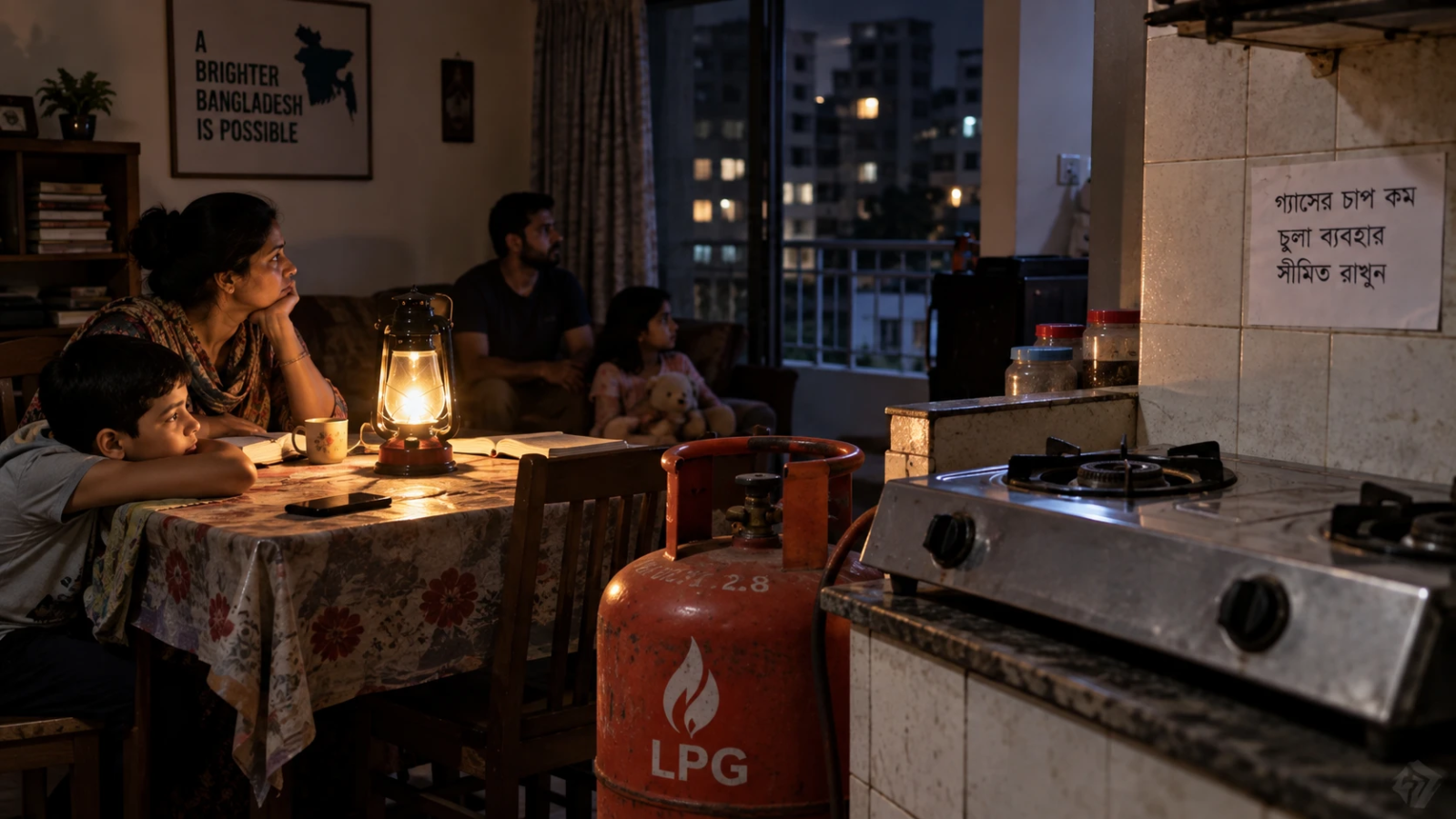
DHAKA — Bangladesh households are facing mounting financial pressure as shortages of gas and electricity coincide with factory closures, job losses and persistently high prices for essential goods, leaving many families struggling to balance incomes and expenses.
Gas shortages have forced some households to buy LPG cylinders or use electric stoves, while frequent power outages have disrupted daily activities. Although the country’s inflation rate has eased in recent months, the prices of many essential commodities remain significantly higher than they were previously.
Gas shortages have worsened in several parts of the country, with many households reporting unreliable supplies. Electricity outages have also become more frequent amid rising demand during hot weather.
Daily gas demand is estimated at about 3 billion cubic feet, while supply has fallen to roughly 1.6 billion cubic feet, according to figures cited in the report.
The shortage has also affected gas-fired power plants. The electricity sector requires about 1.3 billion to 1.4 billion cubic feet of gas a day for power generation, but recent supplies have fallen below 900 million cubic feet.
Electricity demand has exceeded 18,000 megawatts during periods of extreme heat, while supply shortages have at times surpassed 3,500 MW.
“After working all day, I come home hoping to rest, but often the electricity goes out as soon as I arrive,” said Mirpur resident Mahfuzur Rahman.
Afsari Khanam, another resident of the area, said gas shortages that were once largely seasonal had become more frequent, while electricity outages occurred several times a day.
Energy expert B.D. Rahmat Ullah said increasing fuel supplies could help reduce load-shedding, although resolving the shortages immediately would be difficult because additional fuel could not be secured quickly enough.
Factory closures threaten jobs
The energy shortages are adding to difficulties already facing Bangladesh’s industrial sector, where factories are also dealing with weaker orders, financing constraints and liquidity problems.
Data from the Industrial Police, the Bangladesh Garment Manufacturers and Exporters Association (BGMEA) and the Bangladesh Knitwear Manufacturers and Exporters Association (BKMEA) show that at least 80 BGMEA-member factories affected about 19,188 workers through layoffs or job losses during the first six months of 2026. Twenty-seven of those factories closed, according to the figures cited.
Factory closures have been a broader trend. Between August 2024 and February 2025, 95 factories in Gazipur, Savar-Ashulia and Narayanganj-Narsingdi shut permanently, affecting 61,881 workers and employees.
Gazipur recorded 54 closures, followed by 23 in the Narayanganj-Narsingdi industrial area and 18 in Savar-Ashulia-Dhamrai. About 45,732 workers and employees lost their jobs in Gazipur alone.
Commerce Minister Khandaker Abdul Muktadir told parliament last Thursday that more than 400 garment factories had closed between July 2023 and June 2026. Of these, 282 were BGMEA members and 123 were BKMEA members.
The closures have broader economic consequences, reducing household incomes and affecting spending on food, housing, education and other necessities.
Inflation slows but Families cut spending
Bangladesh’s inflation rate has declined, but consumers have yet to see a corresponding reduction in the cost of living.
According to the Bangladesh Bureau of Statistics, headline inflation fell to 8.32% in July from 9.16% in June. Food inflation declined to 7.16% from 8.60%, while non-food inflation stood at 9.28%.
July’s headline inflation was the lowest in eight months.
Economists generally distinguish between a decline in inflation and a decline in prices. A lower inflation rate means prices are increasing at a slower pace; it does not mean that previously elevated prices have fallen.
Consumers continue to face high prices for vegetables, eggs, fish, meat, cooking oil, sugar, flour and other basic goods.
“If gas and electricity shortages are really pushing up the prices of sugar and flour, then we are in serious trouble,” shopper Kawsar Ahmed said.
For many households, higher food prices are only part of the problem. The cost of LPG, alternative power supplies, transport, education, healthcare and housing is adding to monthly expenses.
Families whose incomes have remained unchanged are increasingly cutting discretionary spending and reducing purchases of relatively expensive foods. Those affected by job losses may have to draw down savings or borrow to meet basic expenses.
The combined effect of energy shortages, employment losses and elevated consumer prices is putting sustained pressure on household budgets.
For millions of Bangladeshis, the key concern is no longer simply whether inflation is falling, but whether their incomes can cover the cost of everyday life.




COMMENTS