

DHAKA — A family-owned company linked to Bangladesh’s State Minister for Local Government, Rural Development and Cooperatives Mir Shah-e-Alam has sought exemptions from taxes, VAT and other duties on imported vitamins and minerals, with the application reportedly accompanied by the state minister’s visiting card.
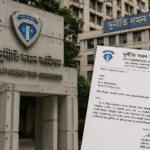
Ruposhi Rice and Pushti Mills submitted the request to the chairman of the National Board of Revenue, or NBR, seeking either a full waiver or special concessions on raw materials used to produce fortified rice, flour and biscuits.
The application was submitted by the company’s managing director, Mir Shakrul Alam Simanta, who is the state minister’s son, according to a report published Thursday by Samakal..
NBR sources said the application seeking the tax waiver or special concessions was submitted with State Minister Mir Shah-e-Alam’s visiting card attached. The NBR has yet to make a decision on the request.
The use of the state minister’s official identity in connection with a request involving his family business has drawn questions about potential conflict of interest.
Transparency International Bangladesh Executive Director Dr. Iftekharuzzaman told Samakal that using an official identity to obtain benefits for a private business represented a clear ethical concern.
“Using an official identity for personal business benefits is a clear ethical lapse and contrary to state policy,” he said. “This not only undermines the dignity of the office, but also creates a conflict of interest, which is unacceptable.”
He said institutions such as the NBR should carry out their responsibilities impartially and should not yield to pressure arising from the exercise of political power.
Company supplies fortified rice kernels to government
Ruposhi Rice and Pushti Mills, located at Betgari Mirbari in Shibganj, Bogura, was established in 2022 and produces fortified rice kernels, according to the company’s letter to the NBR.
The company said it has supplied rice kernels to the Directorate General of Food since 2023.
It said it has so far supplied about 1,198 metric tons of kernels for government food-friendly and Vulnerable Group Development programs. In the private sector, it said it has supplied about 20 tons of kernels and 2,000 tons of fortified rice.
Fortified rice is produced by mixing fortified kernels with ordinary rice at a ratio of approximately one part kernel to 100 parts regular rice.
The kernels require ingredients including vitamins A, B1 and B12, folic acid, iron, zinc, magnesium and calcium carbonate. Similar vitamins and minerals are also used to manufacture fortified flour and biscuits.
Company argues waiver could reduce import costs
In its application, Ruposhi Rice and Pushti Mills said the raw materials needed for fortified food production are not manufactured in Bangladesh.
According to the company, Bangladesh currently has 14 fortified rice kernel producers that import vitamins and minerals as premixed formulations under a single Harmonized System, or HS, code.
The company said importing the ingredients in premixed form is more expensive than importing them separately, resulting in approximately $3 million in foreign currency being spent annually. It argued that the amount could increase as demand grows.
Ruposhi Rice and Pushti Mills said it recently established what it described as Bangladesh’s only domestic premix manufacturing plant.
Under its plan, individual vitamins and minerals would be imported as raw materials and blended locally to produce the premix used by fortified rice kernel manufacturers.
The company claims this could reduce import costs by about 50% and allow other kernel manufacturers to purchase premix locally at lower prices, reducing production costs and saving foreign currency.
It argued that exemptions or special concessions on VAT, taxes and other import duties would help develop a new domestic industry, create jobs and lower the cost of fortified foods.
Lower premix prices would ultimately make fortified rice, flour and biscuits more affordable to low-income and other consumers, the company said.
NBR yet to decide
Samakal said it sought comment from managing director Mir Shakrul Alam Simanta about the application.
According to the newspaper, Simanta answered a telephone call but immediately disconnected it. He did not answer subsequent calls or respond to messages sent to his mobile phone and WhatsApp identifying the sender as a Samakal journalist.
An NBR official, speaking to the newspaper on condition of anonymity, said there was generally no provision for granting an individual private company a separate tax or duty exemption.
If such a concession is granted, it should ordinarily apply to all eligible businesses in the relevant category, the official said. Specific exemptions are generally applicable to government entities, although a limited-time concession could potentially be considered when a particular product is manufactured by only one company in Bangladesh.
Former NBR member Md. Farid Uddin took a firmer position, saying an individual company could not be granted such a benefit under Article 19 of the Constitution.
He said a tax concession could be considered if all companies in a particular sector benefited from it.
Farid Uddin added that even if the NBR forwarded a recommendation for an exemption benefiting a single company, neither the Finance Ministry nor the Law Ministry could legally grant such an individual concession.
The NBR had not made a decision on Ruposhi Rice and Pushti Mills’ application as of the publication of the report.
Courtesy: SAMAKAL | সমকাল



COMMENTS