Foreign Aid Flow to Bangladesh Falls Sharply Amid Economic Uncertainty
Foreign loan inflows to Bangladesh fell 19% in FY2025-26, while debt repayments rose, raising concerns over development spending and economic stability.

Foreign loan inflows to Bangladesh fell 19% in FY2025-26, while debt repayments rose, raising concerns over development spending and economic stability.

Bangladesh records one of its lowest development spending rates in years, with political transition and governance challenges slowing project execution.

Power generation at Barapukuria Thermal Power Plant has fully stopped after a mechanical fault in Unit-1. The shutdown leaves the northern region facing a significant supply deficit.

Bangladesh’s energy crisis deepened Wednesday as a technical fault at the Adani Power plant in India knocked a major generating unit offline. Electricity imports plummeted from 1,497 MW to just 746 MW, leaving the national grid struggling to bridge a 2,500 MW gap during peak heat. With repairs expected to take up to four days, the North and Rangpur regions are bearing the brunt of the shortfall with near-constant load-shedding.

The Bangladesh government has injected Tk 73,000 crore into public welfare and development projects through domestic bank borrowing over the last 60 days. Addressing concerns over inflation, Information Adviser Dr. Jahed Ur Rahman stated that macroeconomic indicators are being closely monitored. He also clarified that fuel reserves remain stable at over 1.2 lakh metric tons, dismissing rumors of a national energy crisis.

A devastating combination of diesel scarcity and rolling blackouts has brought irrigation to a standstill across major agricultural hubs in Bangladesh. From Rangpur to Cox’s Bazar, thousands of pumps are idle as the boro rice crop enters its most sensitive growth stage.
Bangladesh’s telecom sector faces shutdown risks as fuel shortages deepen, threatening nationwide connectivity and critical infrastructure.

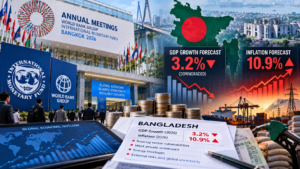
The IMF has slashed its 2026 global growth forecast as the U.S.-Iran conflict disrupts trade. With inflation projected to hit 4.4%, the world faces a high-stakes economic slowdown.

Bangladesh confronts a growing fuel crisis amid global tensions, exposing policy failures and forcing urgent import diversification efforts.

In an emergency move, BERC has raised jet fuel prices by 80%. With domestic fuel now costing Tk 202.29/liter, the aviation industry faces its steepest operational challenge in history.

Foreign loan inflows to Bangladesh fell 19% in FY2025-26, while debt repayments rose, raising concerns over development spending and economic stability.

Bangladesh records one of its lowest development spending rates in years, with political transition and governance challenges slowing project execution.

Power generation at Barapukuria Thermal Power Plant has fully stopped after a mechanical fault in Unit-1. The shutdown leaves the northern region facing a significant supply deficit.

Bangladesh’s energy crisis deepened Wednesday as a technical fault at the Adani Power plant in India knocked a major generating unit offline. Electricity imports plummeted from 1,497 MW to just 746 MW, leaving the national grid struggling to bridge a 2,500 MW gap during peak heat. With repairs expected to take up to four days, the North and Rangpur regions are bearing the brunt of the shortfall with near-constant load-shedding.

The Bangladesh government has injected Tk 73,000 crore into public welfare and development projects through domestic bank borrowing over the last 60 days. Addressing concerns over inflation, Information Adviser Dr. Jahed Ur Rahman stated that macroeconomic indicators are being closely monitored. He also clarified that fuel reserves remain stable at over 1.2 lakh metric tons, dismissing rumors of a national energy crisis.

A devastating combination of diesel scarcity and rolling blackouts has brought irrigation to a standstill across major agricultural hubs in Bangladesh. From Rangpur to Cox’s Bazar, thousands of pumps are idle as the boro rice crop enters its most sensitive growth stage.
Bangladesh’s telecom sector faces shutdown risks as fuel shortages deepen, threatening nationwide connectivity and critical infrastructure.

The IMF has slashed its 2026 global growth forecast as the U.S.-Iran conflict disrupts trade. With inflation projected to hit 4.4%, the world faces a high-stakes economic slowdown.

Bangladesh confronts a growing fuel crisis amid global tensions, exposing policy failures and forcing urgent import diversification efforts.

In an emergency move, BERC has raised jet fuel prices by 80%. With domestic fuel now costing Tk 202.29/liter, the aviation industry faces its steepest operational challenge in history.

Foreign loan inflows to Bangladesh fell 19% in FY2025-26, while debt repayments rose, raising concerns over development spending and economic stability.

Bangladesh records one of its lowest development spending rates in years, with political transition and governance challenges slowing project execution.

Power generation at Barapukuria Thermal Power Plant has fully stopped after a mechanical fault in Unit-1. The shutdown leaves the northern region facing a significant supply deficit.

Bangladesh’s energy crisis deepened Wednesday as a technical fault at the Adani Power plant in India knocked a major generating unit offline. Electricity imports plummeted from 1,497 MW to just 746 MW, leaving the national grid struggling to bridge a 2,500 MW gap during peak heat. With repairs expected to take up to four days, the North and Rangpur regions are bearing the brunt of the shortfall with near-constant load-shedding.

The Bangladesh government has injected Tk 73,000 crore into public welfare and development projects through domestic bank borrowing over the last 60 days. Addressing concerns over inflation, Information Adviser Dr. Jahed Ur Rahman stated that macroeconomic indicators are being closely monitored. He also clarified that fuel reserves remain stable at over 1.2 lakh metric tons, dismissing rumors of a national energy crisis.

A devastating combination of diesel scarcity and rolling blackouts has brought irrigation to a standstill across major agricultural hubs in Bangladesh. From Rangpur to Cox’s Bazar, thousands of pumps are idle as the boro rice crop enters its most sensitive growth stage.
Bangladesh’s telecom sector faces shutdown risks as fuel shortages deepen, threatening nationwide connectivity and critical infrastructure.

The IMF has slashed its 2026 global growth forecast as the U.S.-Iran conflict disrupts trade. With inflation projected to hit 4.4%, the world faces a high-stakes economic slowdown.

Bangladesh confronts a growing fuel crisis amid global tensions, exposing policy failures and forcing urgent import diversification efforts.

In an emergency move, BERC has raised jet fuel prices by 80%. With domestic fuel now costing Tk 202.29/liter, the aviation industry faces its steepest operational challenge in history.