

Subheading: Israeli Prime Minister Benjamin Netanyahu has proposed a rotating national unity government in which opposition leader Gadi Eisenkot would serve as prime minister first, amid ongoing coalition negotiations following October’s election.
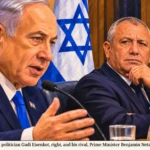
Israeli Prime Minister Benjamin Netanyahu has offered to form a national unity government with opposition leader Gadi Eisenkot, agreeing that Eisenkot would initially become prime minister under a rotating leadership arrangement.
In a social media statement, Netanyahu said he was prepared to put aside the principle that the leader of the largest party should become prime minister, adding that he would serve as an alternate prime minister during the first phase of the proposed government.
Bus Catches Fire While Parked in Pirojpur, Administration Suspects Sabotage
Eisenkot, who was recently tasked by President Isaac Herzog with forming a government within 28 days, welcomed the proposal and invited Netanyahu to begin genuine and accelerated negotiations.
The offer came after Eisenkot accused Netanyahu’s Likud party of delaying coalition discussions ahead of the 6 December deadline.
In October’s election, Eisenkot’s centrist Yashar party and three allied opposition parties secured 48 seats in the 120-member Knesset. Netanyahu’s political bloc won 53 seats, leaving both sides short of the 61 seats required for a parliamentary majority.
Two Arab-led alliances, the United Arab List and the Joint List, collectively secured 19 seats, potentially giving them significant influence in government formation. However, most Jewish parties had previously ruled out forming a coalition with Arab-led parties.
Meanwhile, moderate Islamist Raam leader Mansour Abbas suggested that his party’s position on Hamas could open the door to participating in a coalition aimed at replacing Netanyahu. Abbas confirmed that Raam had supported legislation involving the designation of Hamas as a terrorist organisation.
Eisenkot has already reached coalition agreements with Yisrael Beiteinu and The Democrats. His ally, former Prime Minister Naftali Bennett, has also expressed support for a unity government involving Likud, with Eisenkot serving as prime minister first.
Netanyahu said his proposal was driven by what he described as the seriousness of the threats facing Israel and the need for a government capable of addressing them.
Responding to the offer, Eisenkot said he was ready to examine Netanyahu’s intentions over the next 24 hours, provided Likud was serious about achieving genuine political unity.
Israel has historically been governed through coalition arrangements, as no single political party has secured an outright parliamentary majority. Political divisions between Netanyahu and his rivals previously contributed to five national elections between 2019 and 2022.
The proposed unity government could reshape Israel’s political landscape, but its formation will depend on whether the rival parties can reach an agreement before the coalition negotiations deadline.
Clarify the coalition arithmetic
Tighten the political context
Add a stronger news-style lead





COMMENTS