

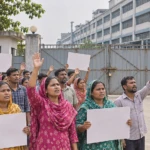
Fresh protests by garment workers erupted in Savar, Ashulia and Gazipur on Tuesday, disrupting production and traffic across major industrial areas as workers continued demanding a minimum monthly wage of Tk 30,000.
Workers staged demonstrations, stopped work and blocked several roads, including parts of the Dhaka-Mymensingh Highway. Police fired tear gas shells and sound grenades to disperse protesters as tensions escalated in several locations.
The renewed unrest follows the postponement of a scheduled meeting of the Minimum Wage Board, which was expected to discuss proposals for revising garment workers’ wages.
Protests Spread Across Gazipur
Workers began demonstrating in front of the Euro Jeans factory in Bhogra, Gazipur, at around 8:30am.
The protests subsequently spread to Bhogra Bypass and surrounding areas. Workers blocked sections of the Dhaka-Mymensingh Highway, causing severe traffic disruption.
Major Reshuffle in Bangladesh Army: Seven Major Generals Reassigned, Three Brigadiers Promoted
Around 9:15am, protesters broke part of a road divider on the Bhogra-Tangail road and placed it across the carriageway, halting traffic.
Police responded by firing sound grenades, while clashes and chasing between workers and law enforcement personnel were reported in the area.
Hundreds of workers also gathered along the road between Bhogra and Nawjor in solidarity with the demonstrators.
Tension Escalates in Savar and Ashulia
In Savar’s Hemayetpur area, workers from several factories refused to join their shifts and blocked the Hemayetpur-Keraniganj road near Padma Mor at around 8:30am.
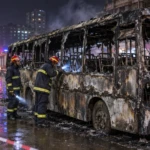
Witnesses said protesters set tyres on fire as they blocked the road.
Police and Border Guard Bangladesh (BGB) personnel attempted to clear the area. As tensions escalated, law enforcement agencies fired tear gas shells and sound grenades to disperse the demonstrators.
Meanwhile, workers from several factories in Narsinghpur and Zirabo areas of Ashulia also left their workplaces without starting production.
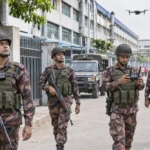
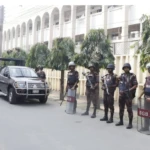
Authorities deployed additional security personnel to maintain order across the industrial belt.
At Least 26 Factories Closed in Gazipur
The labour unrest has disrupted operations at dozens of garment factories. According to The Business Standard, at least 26 garment factories in Gazipur remained closed indefinitely on Tuesday, while several others announced general holidays after workers refused to join their shifts.
In Savar and Ashulia, eight factories were reportedly closed under Section 13(1) of the Bangladesh Labour Act, while three others declared general holidays.
Production was also suspended at several other factories amid continuing demonstrations.
Postponed Wage Board Meeting Triggers Anger
The postponement of the Minimum Wage Board meeting has emerged as a major trigger for the renewed protests.
The third meeting, scheduled for November 16, was postponed after workers’ representative Anwar Hossain reportedly fell ill and was admitted to hospital.
At the previous meeting on November 9, workers’ representatives proposed raising the minimum monthly wage to Tk 32,000.
The current minimum wage for garment workers is Tk 12,500.
Wage Board Chairman Syed Azad Subhani said a new date for the meeting had not yet been fixed, although the board’s work was continuing.
Both workers’ representatives and garment manufacturers’ associations have called for the meeting to be rescheduled as soon as possible.
Workers Seek Higher Wages Amid Rising Living Costs
Garment workers say their existing salaries are insufficient to meet the rising costs of food, housing, healthcare, transportation and other essential expenses.
They argue that a substantial increase in the minimum wage is necessary to ensure a decent standard of living for millions of workers employed in the country’s garment industry.
The workers’ demand for Tk 30,000 has remained at the centre of demonstrations across the country’s major industrial zones.
Authorities on Alert as Unrest Continues
Police, BGB and other law enforcement agencies have increased their presence in key industrial areas to prevent further escalation.
Officials are working to restore normal traffic movement and persuade workers to return to their workplaces.
However, uncertainty over the next Wage Board meeting and the absence of an agreed wage proposal continue to fuel tensions between workers and factory owners.
The situation in Savar, Ashulia and Gazipur remains a major concern for Bangladesh’s export-oriented garment industry, with workers, manufacturers and international buyers closely monitoring developments.
The coming days are likely to be crucial in determining whether negotiations can resolve the dispute and restore normal production across the industrial belt.
COMMENTS