
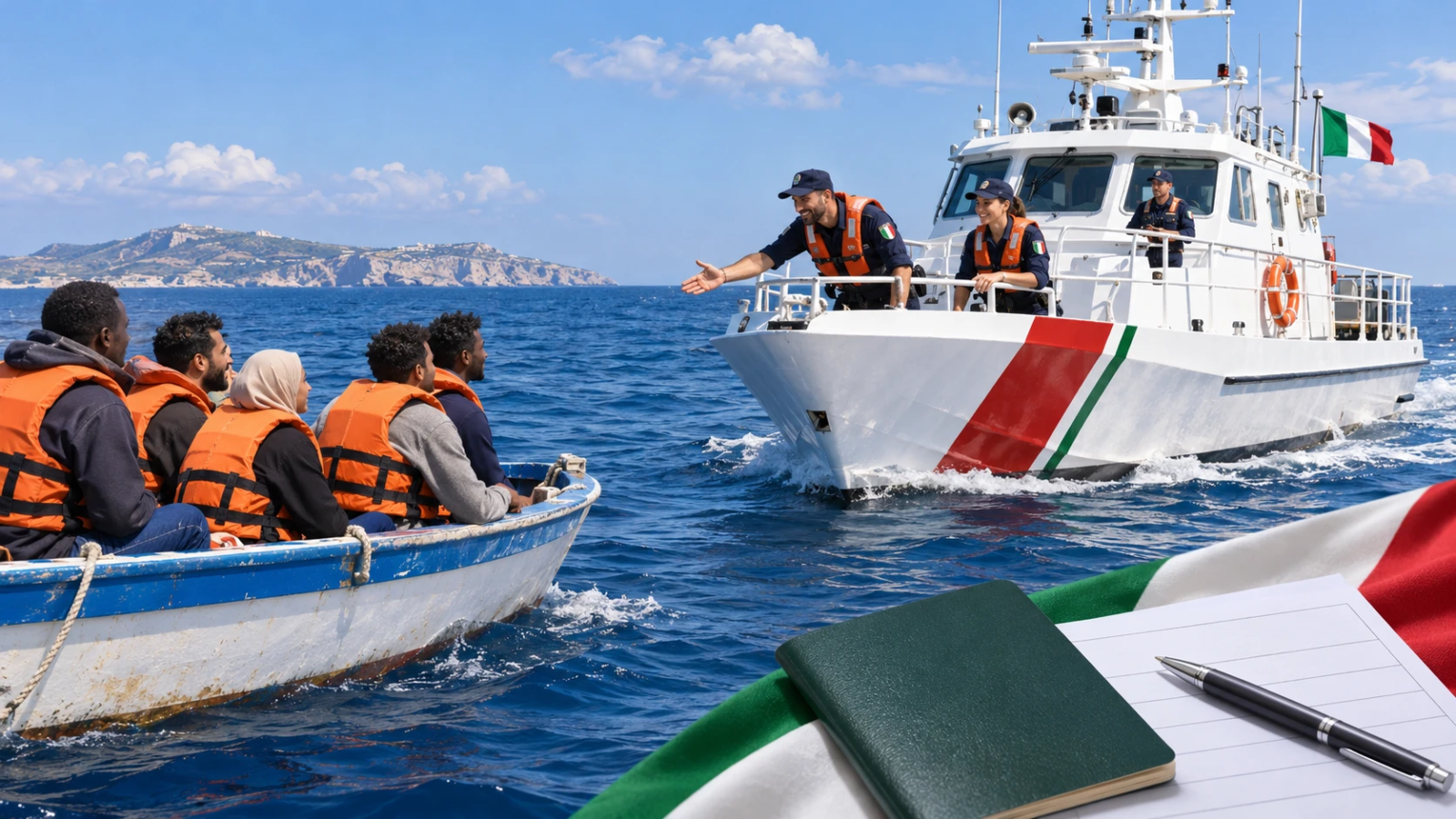
Italy is moving to tighten its immigration controls, introducing tougher measures against irregular migration while expanding legal pathways for foreign workers. The new measures could make dangerous journeys to Italy even riskier for Bangladeshis attempting to reach Europe through irregular routes.
Italy’s Cabinet, led by Prime Minister Giorgia Meloni, approved a new migration bill in February aimed at curbing irregular migration, speeding up the deportation of undocumented migrants and strengthening border surveillance. At the same time, the government plans to increase opportunities for legal migration through its 2026–2028 Flows Decree.
Tougher Measures Against Irregular Migration
The proposed legislation seeks to simplify the deportation process for people residing in Italy without valid documents and strengthen surveillance along regional borders. It also sets a maximum four-month period for decisions on asylum applications.
Under exceptional circumstances involving serious threats to public order or national security, the Italian Navy could detain migrant-carrying vessels in international waters for up to six months. The government would also have the authority to prohibit boats from entering Italian territorial waters.
Italy has also established two migrant detention centres in Albania under a bilateral agreement. The facilities in Shengjin and Gjader are now being used as return hubs to detain migrants whose asylum applications have been rejected before deportation.
The European Union’s new Migration and Asylum Pact, which took effect on June 12, provides opportunities for rejected asylum seekers to be transferred to third countries outside the bloc.
The Italian government says the measures are necessary to combat human trafficking and irregular border crossings. However, rights organisations, including Human Rights Watch and Amnesty International, have criticised the approach, warning that transferring migrants to Albania could undermine their human rights.
The bill is awaiting approval from both chambers of the Italian Parliament. If passed, enforcement against undocumented migrants could intensify further this year.
Italian Ambassador Urges Bangladeshis to Choose Legal RoutesItalian Ambassador to Bangladesh Antonio Alessandro has said Italy will take a tougher stance against irregular migration, human trafficking and migrant smuggling.
He urged Bangladeshis not to risk their lives crossing the Mediterranean Sea through Libya in an attempt to reach Europe.
Instead, Italy wants prospective migrants to pursue legal migration channels, the ambassador said, advising people to verify information through official government agencies rather than relying on brokers.
He also stressed that going abroad is not the only route to success.
A Foreign Ministry official in Dhaka said Bangladesh encourages legal migration to all countries, adding that irregular migration damages the country’s reputation.
New Legal Opportunities for Bangladeshi Workers
Despite the tougher stance on irregular migration, Italy is expanding opportunities for foreign workers, including Bangladeshis.
Under the country’s 2026–2028 Flows Decree, Italy plans to recruit a total of 497,550 foreign workers over three years.
The annual allocations are:
2026: 164,850 workers
2027: 165,850 workers
2028: 166,850 workers
Bangladesh has been included among the countries eligible for reserved recruitment quotas, partly in recognition of its cooperation in the repatriation of irregular migrants.
Another significant opportunity is available under Article 23 of Italy’s immigration law. Under this provision, workers who complete pre-departure training approved by Italy’s Ministry of Labour can migrate legally outside the annual quota system throughout the year.
The training programme includes Italian language instruction, civic education and technical skills development.
According to Ambassador Alessandro, Italian employers will bear the entire cost of the training, meaning workers will not have to pay brokers or intermediaries. He warned that visas could be cancelled if evidence emerges that applicants have paid brokers for the programme.
Albania Ready to Extend Migration Agreement
Albanian Prime Minister Edi Rama has indicated that his country is ready to extend its controversial migration agreement with Italy if Rome wishes to continue it.
Speaking at the Euronews Enlargement Summit on Tuesday, November 3, Rama said the agreement would remain in place for as long as necessary.
Signed in 2023 and implemented in March 2024, the agreement initially runs for five years, with renewal scheduled for 2029. It allows Italy to transfer irregular migrants to Albania before returning them to their countries of origin.
The arrangement has effectively shifted part of Italy’s migration management outside EU territory. Questions had emerged over its future as Albania seeks to join the European Union, but Rama dismissed concerns about the agreement’s continuation.
Controversial Centres Face Questions Over Cost and Effectiveness
Italy’s two migrant centres in Shengjin and Gjader currently house fewer than 100 undocumented migrants, according to media reports, although the Italian government has not officially disclosed the number.
An investigative report recognised with the European Parliament’s Daphne Caruana Galizia Prize found that Italy spent approximately one million euros per detained person during the centres’ first two years.
Initially, the facilities were intended to process asylum applications from migrants rescued at sea. Following repeated legal challenges, the Meloni government changed their purpose in March 2025, turning them into detention facilities for irregular migrants already present in Italy who are awaiting deportation.
Bangladeshis Lead Mediterranean Migration Attempts
Bangladeshis were the largest nationality group attempting to reach Europe through the Central Mediterranean route in 2025.
According to a joint annual report by the International Organization for Migration (IOM) and the UN refugee agency UNHCR, a total of 100,777 departure attempts from Libya, Tunisia and Algeria towards Italy and Malta were recorded last year. Bangladeshis accounted for 22 per cent of those attempts.
They also represented the largest nationality group among migrants arriving in Italy.
A total of 65,081 migrants reached Italy through the Central Mediterranean route in 2025. Bangladeshis accounted for 31.1 per cent of arrivals, followed by Egyptians at 14 per cent, Eritreans at 11.7 per cent and Pakistanis at 6.7 per cent.
Libya remained the main departure point, with an estimated 82,104 people attempting the journey from the country, an 18 per cent increase from the previous year. Bangladeshis constituted the largest nationality group among those departing from Libya.
The trend was particularly evident in Malta, where Bangladeshis accounted for 64 per cent of the 246 migrants who arrived from Libya in 2025.
The report also highlighted the demographic profile of Bangladeshi arrivals in Italy: 92 per cent were men, while children accounted for just seven per cent, indicating that the migration was largely driven by employment-related motives.
Mediterranean Remains One of the World’s Deadliest Routes
Despite a decline in recorded fatalities, the Central Mediterranean remains one of the world’s deadliest migration routes.
According to the IOM’s Missing Migrants Project, 1,330 people died or went missing along the route in 2025, compared with 1,754 in 2024, representing a 24 per cent decline.
Across the Mediterranean’s eastern, central and western routes, as well as the Atlantic route from West Africa, approximately 3,400 people died or went missing in 2025, down from 3,800 the previous year.
So far this year, 1,038 people have died or gone missing along the Central Mediterranean route. Their nationalities have not been fully established.
Since the Missing Migrants Project began recording deaths in 2014, more than 20,000 deaths and disappearances have been documented across the Mediterranean. More than 17,000 of those cases occurred along the Central Mediterranean route between Libya and Tunisia and Italy.
Many migrants face detention, kidnapping, ransom demands, forced labour and human trafficking in Libya and other transit countries before even beginning the dangerous sea journey.
Boats are often overcrowded and unfit for long-distance travel, while rescue capacity remains limited. Many shipwrecks go unrecorded, and bodies are never recovered, suggesting that the actual death toll could be significantly higher.
Brokers Exploit Young People With False Promises: BRAC
Shariful Hasan, associate director of BRAC’s Migration and Youth Platform, said irregular migration to Europe from Bangladesh was concentrated in particular districts rather than being widespread across the country.
He identified Shariatpur, Madaripur, Faridpur, Sylhet, Sunamganj, Noakhali and Cumilla among the major areas from which people attempt to reach Europe through irregular channels.
According to Hasan, brokers exploit the aspirations of young people and their families by promising well-paid jobs and better lives in Europe, often making claims that do not reflect reality.
He called for greater public awareness, coordinated law enforcement operations against local brokers and human trafficking networks, and investigations into financial transactions linked to trafficking.
He also urged international cooperation to dismantle trafficking networks operating in Libya and other countries.
With Italy tightening its immigration controls while offering expanded opportunities through legal recruitment programmes, the message for Bangladeshis is increasingly clear: irregular migration carries growing risks, while verified legal channels offer a safer alternative.






COMMENTS