
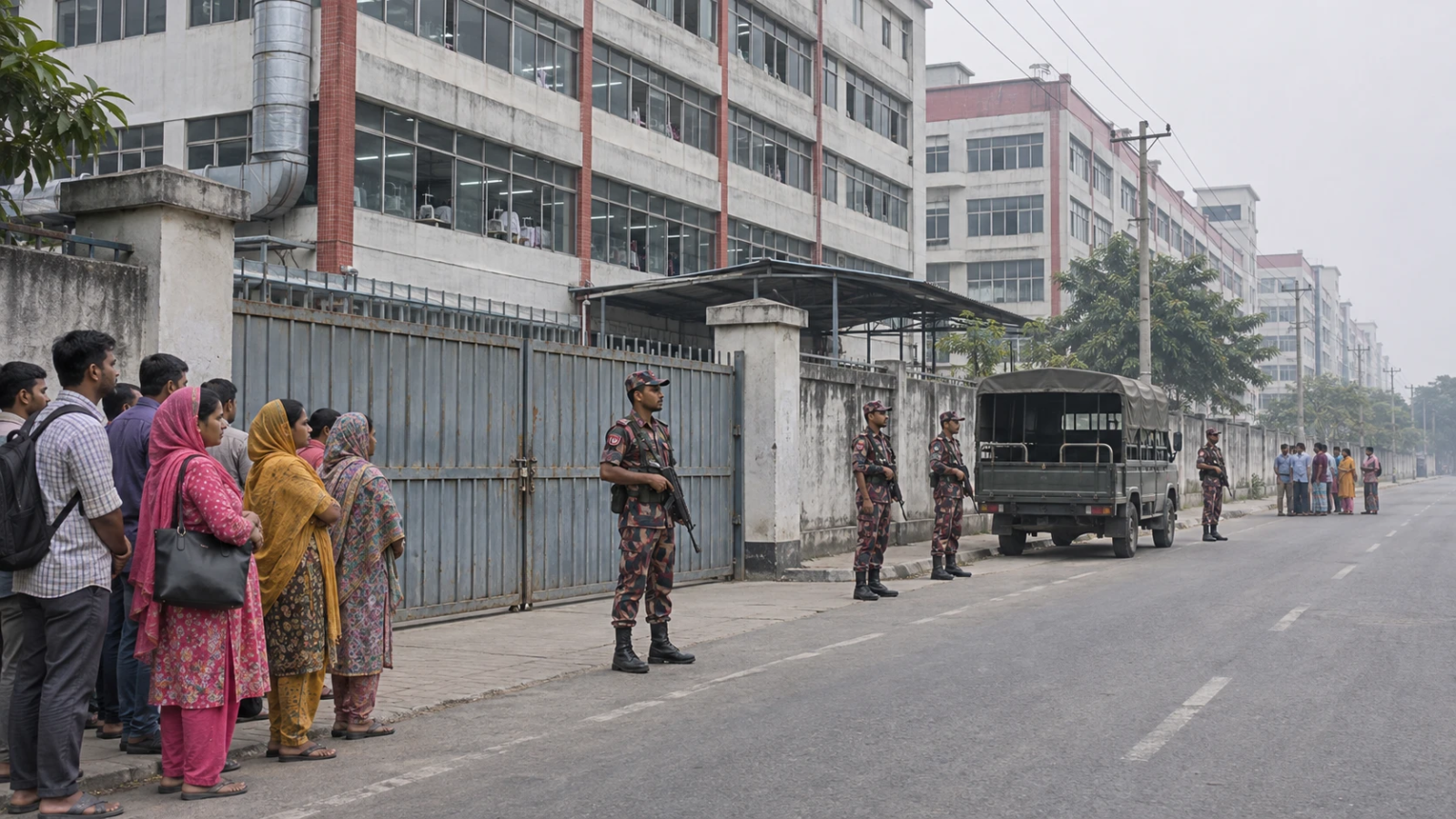
Wage-hike demonstrations paralyse industrial belts in Gazipur, Ashulia, Narayanganj and Mirpur, prompting BGB deployment; government assures factory owners that a new minimum wage structure will be finalised by December as rights groups back workers’ Tk 32,000 monthly wage demand.
At least 469 garment factories across Bangladesh were forced to declare holidays on Tuesday as workers staged widespread demonstrations demanding higher wages, bringing traffic to a standstill in major industrial areas and prompting Prime Minister Tarique Rahman to intervene in the escalating unrest.
The demonstrations in Gazipur, Ashulia, Narayanganj and Mirpur caused hours of severe traffic congestion, leaving commuters stranded, according to witnesses.
In a significant development, Bangladesh Garment Manufacturers and Exporters Association (BGMEA) President Mahmud Hasan Khan met Prime Minister Tarique Rahman on Tuesday evening to brief him on the overall situation in the readymade garment (RMG) sector.
A leader of the garment manufacturers’ and exporters’ association said Mahmud Hasan Khan requested the prime minister to take steps to ensure that the newly formed wage board convenes its first meeting immediately and announces a new pay structure in accordance with labour law.
According to the BGMEA, 199 factories in Gazipur, 191 in Ashulia, 59 in Mirpur and 20 in Narayanganj were compelled to declare holidays after workers joined their shifts but subsequently left production lines amid the protests.
Traffic Disruptions and Security Deployment
As workers attempted to block roads and clashed intermittently with police, 12 platoons of paramilitary Border Guard Bangladesh (BGB) personnel were deployed in Gazipur and Narayanganj to maintain order.
Around noon, workers from several factories gathered at Padmar crossing near the Hemayetpur-Singair road. They dispersed after police persuaded them to leave, witnesses and law-enforcement officials said.
However, at approximately 3:30 pm, protesters blocked the Dhaka-Aricha Highway at Hemayetpur, triggering long traffic tailbacks on both sides and leaving commuters stranded. The blockade was withdrawn around 5:40 pm, after nearly two hours.
In Gazipur, garment workers attempted to block the Dhaka-Tangail Highway at several locations, severely disrupting traffic and prompting the deployment of additional law-enforcement personnel.
Earlier, at around 9:30 am, workers blocked the highway in the Naojor area of Gazipur and set fire to roadside waste, bringing vehicular movement between Joydebpur Chowrasta and Naojor intersection to a complete halt.
Witnesses said protesters prevented even small vehicles, including auto-rickshaws and motorcycles, from passing. They also obstructed journalists attempting to photograph and record the demonstrations.
Workers from factories in Bhogra, Palli Bidyut and Chandra also attempted to take to the highway but were dispersed by law-enforcement personnel.
Government Warns Against Factory Closures
Speaking to journalists at the Secretariat, Home Minister Salahuddin Ahmed warned that strict legal action would be taken against anyone attempting to forcibly shut down factories or create instability.
He alleged that elements linked to the ousted regime were attempting to exploit the unrest for political gain. He also said steps were being taken to reopen closed factories and maintained that workers’ wage demands were already being addressed through the newly formed Minimum Wage Board.
Industry leaders, meanwhile, said the government had assured them that garment factories would reopen on Wednesday morning and resume operations according to their regular schedules, with security arrangements in place.
The government has directed the RMG sector’s minimum wage board to finalise a new pay structure by December, raising expectations that a revised minimum wage could be announced in the coming months.
A BGMEA vice-president said industry representatives had received assurances from the highest level of government that the new wage structure would be finalised by December. The wage board could begin negotiations as early as Wednesday, the official added.
“We are ready to implement the new wage structure,” the BGMEA vice-president said.
Following a meeting with senior journalists at the Pan Pacific Sonargaon Hotel on Tuesday evening, BGMEA President Mahmud Hasan Khan said the association hoped the wage board would hold its first meeting on Wednesday to send a positive message to workers.
Unions Cite Rising Living Costs
In a joint statement issued on Tuesday, Bangladesh Trade Union Sangha (BTUS) President Chowdhury Ashikul Alam and General Secretary Rajat Biswas said workers had been driven to the streets by the rising costs of essential food items, energy, housing and healthcare.
The continuing unrest reflects growing pressure on garment workers struggling to meet living expenses, as labour organisations demand a substantial increase in minimum wages.
Global Campaign Backs Tk 32,000 Wage Demand
International labour rights organisation Clean Clothes Campaign (CCC) has urged global fashion brands sourcing garments from Bangladesh to publicly support workers’ demand for a minimum monthly wage of Tk 32,000.
The organisation called on international brands to absorb the resulting increases in labour costs rather than shifting the burden onto suppliers and workers.
Alongside higher wages, workers are demanding an end to practices such as blacklisting and union-busting, the CCC said, urging the newly formed wage board to address these concerns as part of its deliberations.
The campaign also called on international brands to commit publicly to continuing their sourcing operations in Bangladesh after the minimum wage is increased.
It further urged suppliers, the BGMEA and the Bangladesh Knitwear Manufacturers and Exporters Association (BKMEA) to support and implement the proposed Tk 32,000 monthly minimum wage and fully reflect the higher labour costs in their purchasing prices.
With hundreds of factories affected and demonstrations disrupting key transport routes, the immediate challenge for the government and industry leaders is to restore normal production while addressing workers’ demands for higher wages and improved labour conditions.
Dhaka, 4th November

COMMENTS